

A growing body of research is revealing a stark and troubling reality. The less education a person has, the more likely they are to die from causes that modern medicine can prevent. Two major studies, one conducted in the United States and another in India, arrive at the same conclusion from very different angles. Education is not just about opportunity or income. It is increasingly becoming a matter of life and death.
This article brings together findings from researchers led by Dr. Steffie Woolhandler and Dr. Adam Gaffney in the United States, along with a major international study conducted by the International Institute for Applied Systems Analysis in India. Despite differences in geography, healthcare systems, and economic conditions, both sets of research point in the same direction. Education plays a central role in determining who lives longer and who does not.
The American Study: A Growing Divide in Preventable Deaths
In the United States, researchers analyzed an enormous dataset covering more than 476,000 adults over a 25 year period. They combined this with over 26 million death certificates to understand how access to healthcare and education levels influenced mortality rates.
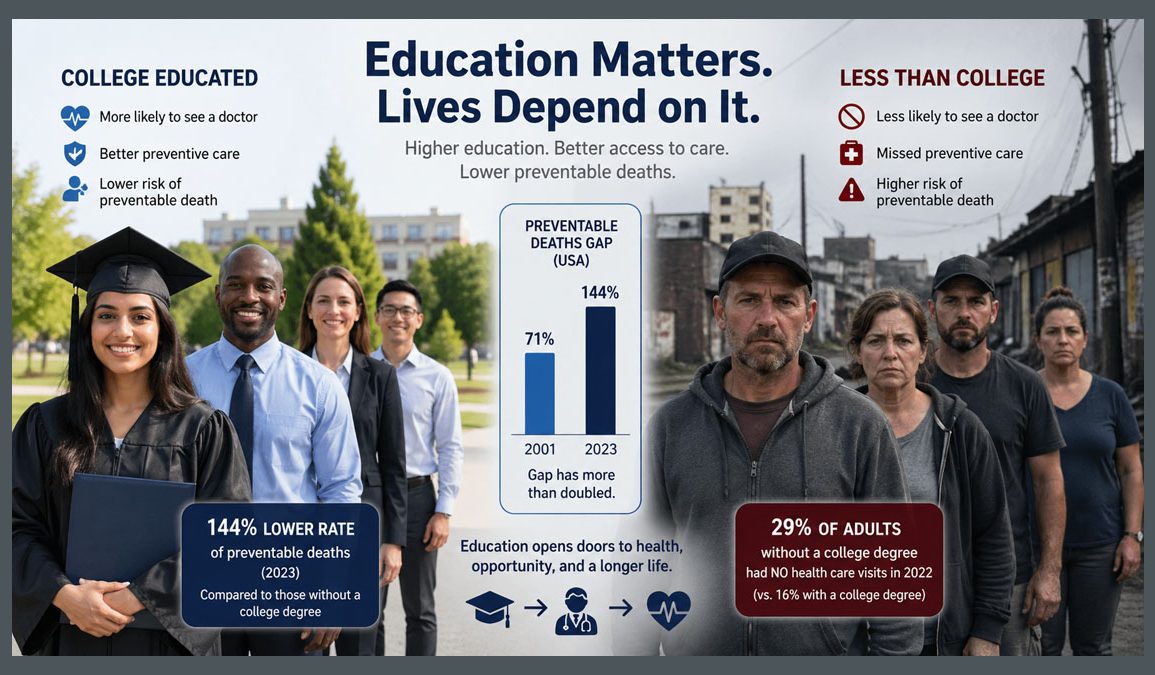
Their findings were striking. By 2023, people without a college degree had a 144 percent higher rate of medically preventable deaths compared to those with at least a bachelor’s degree. This gap has widened dramatically over time. In 2001, the difference was already significant at 71 percent, but it has more than doubled since then.
The researchers did not just look at death rates. They also examined how often people accessed healthcare. In 1996, about 26 percent of adults without a college degree had no healthcare visits in a given year, compared to 20 percent of those with a degree. By 2022, the gap had widened sharply. Nearly 29 percent of less educated adults went without any healthcare, compared to just 16 percent of college graduates.
Even more concerning was what they found among people with chronic illnesses. In 2022, 24 percent of individuals without a college degree who had serious health conditions did not see a doctor at all during the year. Among college graduates, that number was 16 percent.
Dr. Steffie Woolhandler expressed deep concern about what lies ahead. “I fear for the future. Millions are set to lose Medicaid and ACA coverage, most of whom lack a college degree,” she said. “That’s a group that already struggles to get the care they need to prevent premature death.”
Dr. Adam Gaffney emphasized that this research challenges long held assumptions. “Many experts have doubted that poor access to health care is a major contributor to those mortality differences,” he explained. “While many factors undoubtedly contribute to these disparities, our findings indicate that lack of health care puts people in mortal danger.”
The conclusion was clear. A large and growing number of Americans, especially those with less education, are not receiving basic medical care. As a result, they are dying from conditions that could have been treated or prevented.
The India Study: Education Matters More Than Wealth
While the American study focused on healthcare access, researchers in India approached the problem from a different perspective. They wanted to understand why premature death remains high in a country that has experienced rapid economic growth.
The study tracked more than 115,000 individuals over several years using nationally representative data. Researchers examined how education levels and household wealth influenced the risk of dying between the ages of 15 and 59.
Their findings were equally revealing. Education had a stronger and more consistent relationship with survival than income or wealth. People with higher levels of education were less likely to die prematurely, regardless of how wealthy they were.
Lead researcher Moradhvaj Dhakad explained the significance of this result. “Education shows a stronger association with survival at working ages than household wealth,” he said. “This relationship remains after accounting for health conditions, employment, and other background characteristics.”
In contrast, wealth did not show the same protective effect once education was taken into account. This suggests that simply having more money does not guarantee better health outcomes if education levels remain low.
The study also uncovered an important community effect. People living in areas with higher overall education levels experienced lower mortality rates, even if their own education or income was limited. This was especially true for women.
Co author Erich Striessnig highlighted this broader impact. “Education matters not only for individuals, but also for the communities they live in,” he noted. “This suggests that education shapes social and behavioral environments in ways that influence health beyond individual circumstances.”
Researchers explored possible reasons for these patterns. They found that education influences health behaviors, awareness, decision making, and the ability to navigate healthcare systems. In many cases, the benefits of education were direct rather than being mediated through income or wealth.
As co author Samir K.C. put it, “Sustained reductions in premature adult mortality in India are unlikely to be achieved through income growth alone but are more strongly associated with long term investments in education.”
Where the Research Agrees
Despite being conducted in very different settings, the two studies converge on several key points.
First, education is a powerful predictor of survival. In both the United States and India, higher levels of education are consistently linked to lower mortality rates.
Second, access to healthcare is closely tied to education. In the United States, less educated individuals are far more likely to go without medical care, even when they need it. In India, education influences how people use healthcare and manage their health, even when financial resources are available.
Third, the impact of education extends beyond the individual. Communities with higher education levels tend to have better health outcomes overall. This suggests that education shapes social norms, behaviors, and support systems that benefit everyone.
Finally, both studies challenge the idea that economic growth alone can solve health disparities. While wealth can improve access to resources, it does not replace the role of education in shaping long term health outcomes.
Dr. Gaffney summed up the American findings bluntly. “Far too many Americans, particularly those with less education, never see a doctor in the course of the year, even if they have a serious chronic illness.”
In India, Wolfgang Lutz highlighted the broader policy implications. “By showing that education consistently outweighs household wealth as a predictor of survival, the study highlights a clear policy lever for accelerating progress toward health and education goals.”
The message from both groups is clear. Investments in education are not just about economic development or social mobility. They are essential for saving lives.