


The Belly Fat Mystery
As people reach middle age, it’s common to gain weight around the midsection—even when overall weight stays the same. This stubborn belly fat doesn’t just affect appearance. It increases the risk for heart disease, diabetes, and even speeds up the aging process. But while this phenomenon is well known, the exact reason why it happens has remained unclear.
Now, researchers at City of Hope, working with scientists from UCLA, have discovered a surprising answer: aging stem cells in belly fat may be to blame.
A Closer Look at Fat-Making Stem Cells
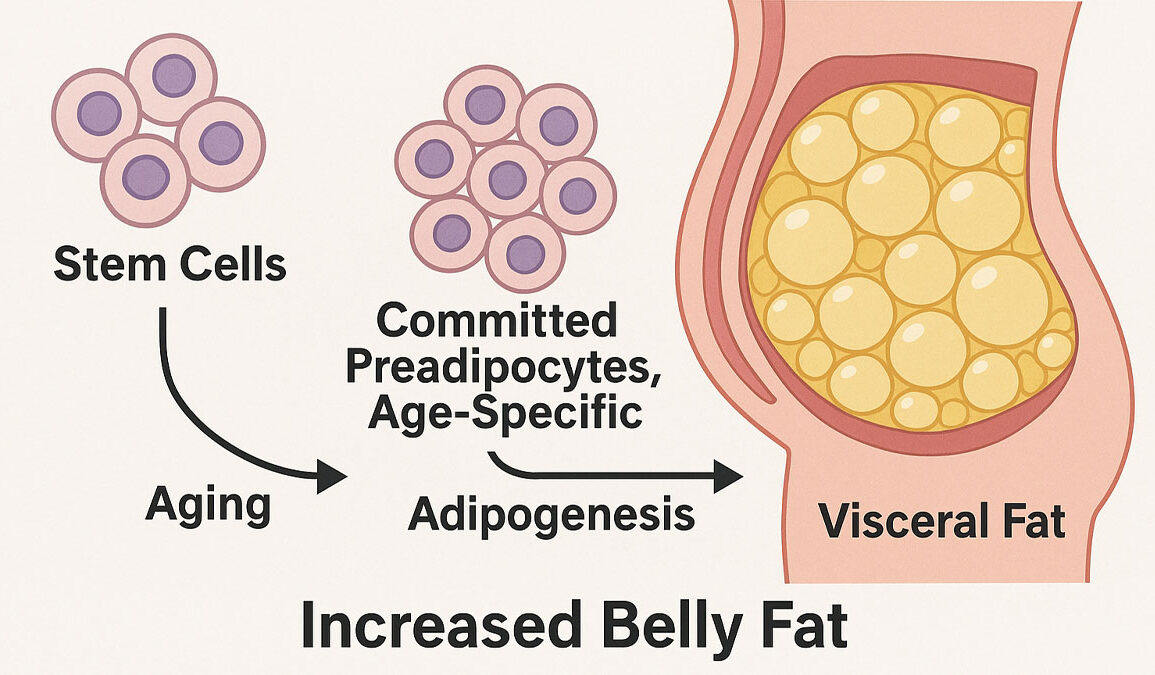
The research, published in Science, focused on white adipose tissue (WAT), the type of fat that builds up around the abdomen. Scientists have long known that as we age, our fat cells get larger. But this study revealed something new—white adipose tissue doesn’t just expand by inflating existing fat cells. It also creates brand-new ones, especially in middle age.
The culprits are a group of stem cells known as adipocyte progenitor cells, or APCs. These cells are normally responsible for making fat cells. But in older bodies, they behave differently. Using mouse models, researchers transplanted APCs from young and old mice into new hosts. The results were striking: APCs from older mice produced large numbers of fat cells, even when transplanted into young mice. In contrast, younger APCs didn’t produce much fat, even when placed into older animals.
Aging Activates a New Kind of Stem Cell
Using advanced RNA sequencing, the scientists discovered that in older mice, APCs begin acting much more aggressively. They don’t slow down with age—instead, they become supercharged, pumping out new fat cells at a high rate.
The team also identified a new type of cell they named CP-As, short for committed preadipocytes, age-specific. These CP-A cells start appearing in middle age and are even more active in creating fat cells. This helps explain why belly fat increases even in people who don’t seem to gain weight elsewhere.
“We discovered aging triggers the arrival of a new type of adult stem cell and enhances the body’s massive production of new fat cells, especially around the belly,” said Dr. Qiong (Annabel) Wang, one of the lead researchers at City of Hope’s Arthur Riggs Diabetes & Metabolism Research Institute.
The LIFR Pathway: A New Target for Treatment
One key finding involved a signaling pathway known as the leukemia inhibitory factor receptor, or LIFR. This pathway plays a major role in helping CP-A cells grow and turn into fat. Young mice don’t need LIFR to make fat, but in older mice, LIFR becomes essential. Blocking this pathway could be a future strategy to stop fat buildup.
“Our research indicates that LIFR plays a crucial role in triggering CP-As to create new fat cells and expand belly fat in older mice,” Wang explained.
Confirming the Findings in Humans
To test whether this process also happens in people, the researchers studied tissue samples from humans of different ages. Sure enough, they found CP-A cells in higher numbers in middle-aged samples, suggesting the same mechanism is at work.
Dr. Adolfo Garcia-Ocana, another leader on the project, emphasized the importance of the discovery: “This is the first evidence that our bellies expand with age due to the APCs’ high output of new fat cells.”
Now that scientists have identified the cells and pathways behind age-related belly fat, the next step is to develop treatments. The research team plans to explore ways to block or remove CP-A cells, potentially preventing or reducing belly fat in middle-aged adults. This could lead to better health outcomes and even longer lifespans.
“Understanding the role of CP-As in metabolic disorders and how these cells emerge during aging could lead to new medical solutions for reducing belly fat and improving health and longevity,” said Wang.
HNZ Editor: A small part of a very big puzzle.