

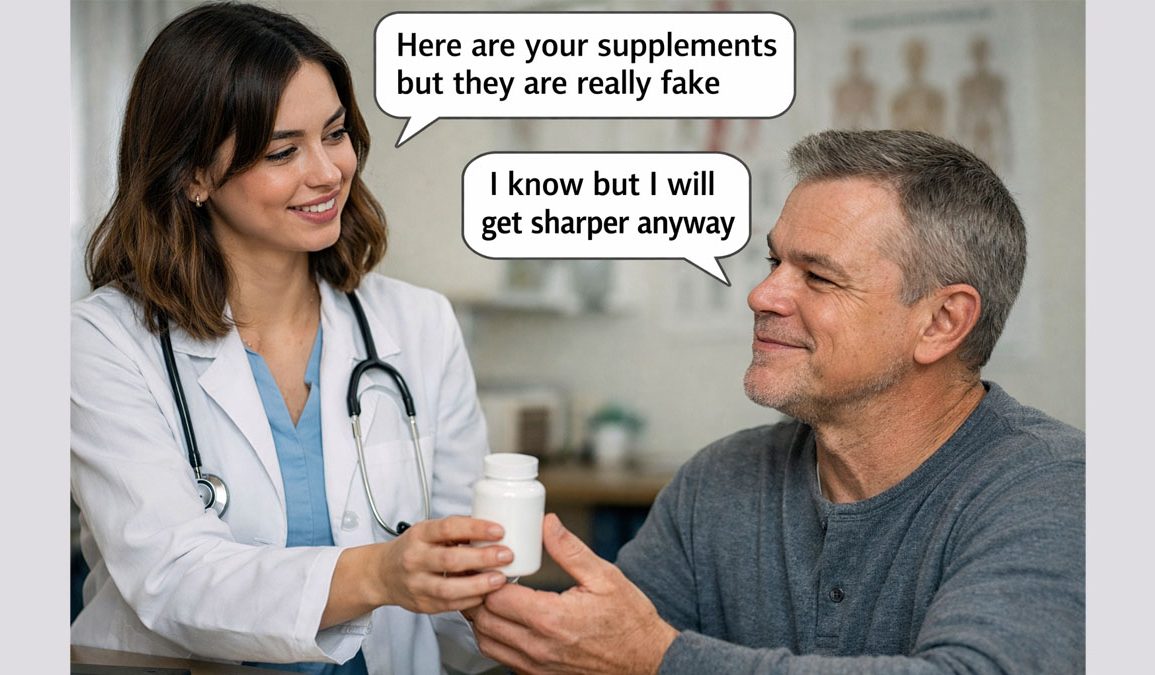
A surprising new line of research suggests that even in later life, meaningful improvements in mental sharpness and physical performance may not require a real drug. In fact, a “fake supplement” has shown measurable results in older adults in just three weeks. The findings point to something far more powerful than pills themselves: the human mind, even in individuals already experiencing the natural effects of aging.
This research, conducted by psychologists at the Università Cattolica in Milan, challenges long-held assumptions about decline in older populations. It suggests that the aging process may be more flexible than previously believed, and that older adults still retain a powerful ability to influence their own cognitive and physical performance.
Who Conducted the Research and Why
The study was led by Diletta Barbiani, Alessandro Antonietti, and Francesco Pagnini, a Full Professor of Clinical Psychology. Their work focused specifically on older adults, a group often assumed to be in steady decline across memory, attention, and physical ability.
“The study is part of an established line of research in which we analyze the role of the mind in aging processes, which is very important,” Pagnini explained.
“Our goal,” he added, “was to clarify whether an open-label placebo therapy or a fake supplement could influence psychological, cognitive, and physical functions in older adults living in the community.”
This focus on older individuals is critical. Rather than studying young or high-performing subjects, the researchers deliberately chose a population where decline is expected, making any improvements more meaningful.
How the Study Was Designed
The researchers enrolled 90 healthy older adults and randomly assigned them to one of three groups. One group received no treatment at all. A second group was given placebo pills and told they contained active ingredients designed to improve well-being. The third group also received placebo pills but were explicitly told that the pills were inert.
Participants completed detailed evaluations before and after the three-week period. These included self-reported measures such as stress, fatigue, sleepiness, optimism, and self-efficacy, along with objective tests of short-term memory, selective attention, and physical performance.
Because the subjects were older adults, these measures were especially important. They targeted areas that typically decline with age, allowing researchers to see whether a simple intervention could counteract those trends.
The Results That Turned Heads
After just three weeks, the results were striking, particularly given the age of the participants.
Older adults who knowingly took a placebo showed lower levels of perceived stress compared to both the deceptive placebo group and the control group. Their short-term memory also improved significantly, a notable outcome in a population where memory decline is common.
Across both placebo groups, physical performance improved as well. The deceived placebo group saw a 7 percent increase, while the open-label group improved by 9.2 percent. For older individuals, even modest gains in physical performance can translate into meaningful improvements in daily life.
Cognitive gains were even more compelling. Depending on the test, improvements ranged from 12.6 percent to 14.6 percent in the deceptive group, and from 6.9 percent to as high as 21.5 percent in the group that knew they were taking a placebo.
“These are significant effects,” Pagnini emphasized, noting that the improvements are comparable to those seen in structured physical activity or cognitive training programs.
Participants also reported reduced drowsiness and improved overall well-being, especially among those who understood they were taking a placebo.
How Can a Fake Supplement Work?
The answer lies in the placebo effect, a phenomenon where beliefs, expectations, and mental states trigger real physiological changes. What makes this study remarkable is that it demonstrates these effects clearly in older adults, a group often thought to be less responsive to such interventions.
Placebo effects are not limited to perception. They can alter biological and behavioral outcomes. Research has shown that fake treatments can produce measurable changes in pain, fatigue, immune responses, and even physical performance.
Expectations play a central role. When older adults believe improvement is possible, the brain works to align the body with that expectation. Attention also matters. Focusing on signs of improvement can amplify positive effects, while reducing attention to discomfort or decline can lessen negative perceptions.
The Possibility of Self-Induced Placebos in Aging
Perhaps the most intriguing implication is that older adults may not need any pill at all to benefit from these effects.
Researchers are now exploring whether individuals can deliberately trigger placebo responses through mental processes. These include mental imagery, where a person visualizes improved health or performance, and somatic focusing, where attention is directed toward positive bodily sensations.
Perceived control also plays a major role. When older individuals feel they have agency over their health, the effects appear to strengthen.
This opens the door to a new model of aging, one where older adults are not passive recipients of decline, but active participants in shaping their physical and cognitive trajectory.
The findings are generating both excitement and caution. On one hand, they suggest a powerful and ethical way to promote healthier aging without relying solely on medication. Open-label placebos could become a new tool to help older adults maintain function and independence.
On the other hand, researchers emphasize the need for careful interpretation. While the mind can influence the body, it is not a replacement for medical treatment in serious conditions.
Still, the implications are difficult to ignore. If older adults can achieve measurable gains in just three weeks using a fake supplement, it challenges the idea that decline is inevitable and unchangeable.