


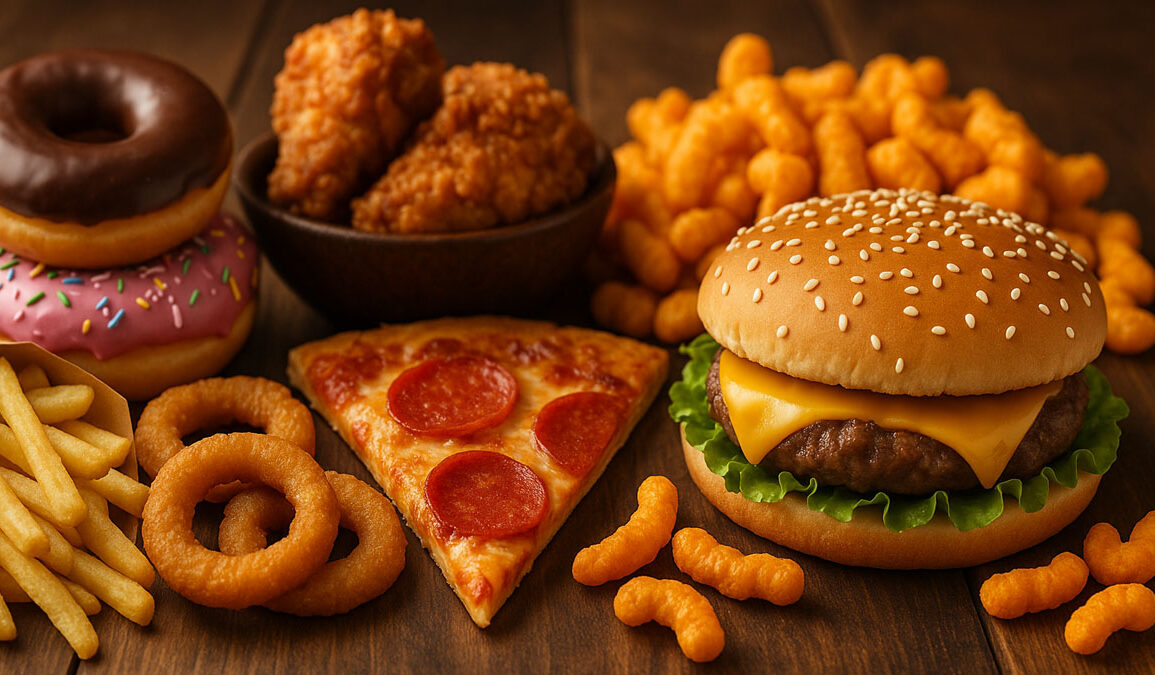
The Junk Food Dilemma
It’s no secret that many of us prefer food we know is bad for us. We’ve been warned for decades that junk food can lead to serious health issues—obesity, heart disease, type 2 diabetes, and even early death. And yet, the average American still gets over half their daily calories from ultra-processed foods.
So, why do we keep reaching for chips, soda, and fast food, even when we understand the risks? The answer lies in a complex web of biology, psychology, marketing, and modern food availability that makes resisting unhealthy food harder than it seems.
The Qualities That Hook Us
Ultra-processed foods are designed to hit our brain’s reward center with precision. These products are packed with refined sugars, unhealthy fats, salt, and chemical additives. According to Dr. Uma Naidoo of Harvard Medical School, these ingredients activate the same dopamine-driven reward pathways in our brain that are triggered by drugs like cocaine.
This “pleasure hit” creates a loop of craving and reward. The more we eat, the more dopamine is released. Over time, just like with drug addiction, our brain builds tolerance—requiring larger amounts to feel satisfied.
Some of the most commonly craved and potentially addictive foods include:
- Pizza
- Potato chips
- Ice cream
- Cheeseburgers
- Candy
- Soda
According to Dr. Ashley Gearhardt, who developed the Yale Food Addiction Scale, these foods show a clear pattern: they’re engineered to be quickly absorbed, hyper-palatable, and satisfying in the short term—even if they’re destructive in the long run.
Addiction or Overindulgence?
Not everyone agrees that food can be classified as addictive. Dr. Johannes Hebebrand argues that unlike drugs or alcohol, food doesn’t create an altered mental state. Still, Gearhardt points out that not everyone who uses cocaine or alcohol becomes addicted either—yet no one questions those substances’ addictive potential. The same may be true for ultra-processed foods.
In fact, Gearhardt’s research found that people trying to cut back on junk food can experience symptoms like irritability, depression, fatigue, and cravings—very similar to withdrawal.
How Modern Life Fuels the Problem
Food addiction doesn’t happen in a vacuum. Today’s environment is engineered to keep us hooked.
In 1980, grocery stores offered around 14,000 items. By 2023, that number had more than doubled to nearly 32,000. This explosion of choice has led to what food experts call “decision fatigue,” making it harder to make healthy choices after a long day.
Apps like DoorDash have made junk food more accessible than ever. “You can order a McDonald’s meal at midnight and have it at your door in 20 minutes,” said weight loss coach Kathrine Brown. “That’s not helping anyone make good decisions.”
Marketing also plays a major role. Shoppers are constantly offered bigger portions for slightly more money, pushing us toward oversized, unnecessary amounts. “You never see regular-size candy bars anymore,” said health podcaster Chuck Carroll. “It’s always king size or jumbo. And we just get used to it.”
The Emotional Link to Overeating
Convenience and habit are only part of the equation. For many, junk food becomes a coping mechanism for stress, anxiety, or depression.
A 2024 study found that 45 percent of consumers now snack specifically to relieve stress—almost triple the rate reported in 2015. Carroll, who once weighed over 400 pounds and ate more than 10,000 calories a day, said his eating patterns mimicked those of a drug addict. “Even when I had chest pains at 22, I couldn’t stop,” he said. “I didn’t even know I was addicted.”
Brown agrees. She says many of her clients use food to regulate emotions, a pattern that can quietly evolve into full-blown dependence.
Junk Food Alters the Brain
According to neuroscientist Dr. Amy Reichelt, junk food physically changes the brain. It inflames brain cells, shrinks memory capacity, reduces the birth of new neurons, and dulls our ability to learn. High-fat, high-sugar foods overwhelm the brain’s reward system and reduce neuroplasticity—the ability to form new neural connections.
Just five days of eating cakes and soda can inflame the hippocampus, the brain’s center for learning and memory, making people feel constantly hungry and emotionally off-balance.
Why We Ignore What We Know
Even though most people recognize junk food as unhealthy, many continue to eat it. In a YouGov poll, over 90 percent of British adults said sugary and deep-fried foods were unhealthy. Yet most still indulged in them regularly. Taste and convenience ranked as the top reasons.
And while nearly 70 percent of those who read nutrition labels said they reconsidered purchases based on what they saw, only 9 percent reported reading those labels every time. It seems that even with knowledge, temptation often wins.
Strategies to Regain Control
So what can be done?
Experts suggest several practical strategies:
- Keep a journal to track what you eat and why. Identifying emotional triggers can help change long-term habits.
- Don’t keep junk food at home. Remove temptation to limit spur-of-the-moment decisions.
- Eat regular meals. Hunger amplifies cravings.
- Reframe portion sizes. Instead of eating a giant dessert all at once, split it into two smaller servings.
- Make whole foods your default. Eating an orange instead of drinking orange juice preserves fiber and reduces sugar spikes.
Brown encourages clients to aim for what she calls a “soul serving”—just enough to satisfy without falling into a binge. And Carroll, who lost 280 pounds after surgery and lifestyle changes, now checks in with his body before eating. “If I’m full, I remind myself that the food will still be there later.”
Our brains are wired to love rich, sugary, salty foods. Food companies know this and engineer products to exploit it. But by understanding the science behind our cravings and making small, intentional changes, we can start to take back control. As Dr. Gearhardt said, the goal is not punishment, but joy—joy in food that nourishes both body and mind.