

Scientists at the University of Cambridge and partners around the world are exploring a fascinating idea: what if pausing a specific kind of cell death could slow down aging itself? The process they are studying is called necrosis, and it might be the hidden trigger for many age-related diseases.
What Is Necrosis?
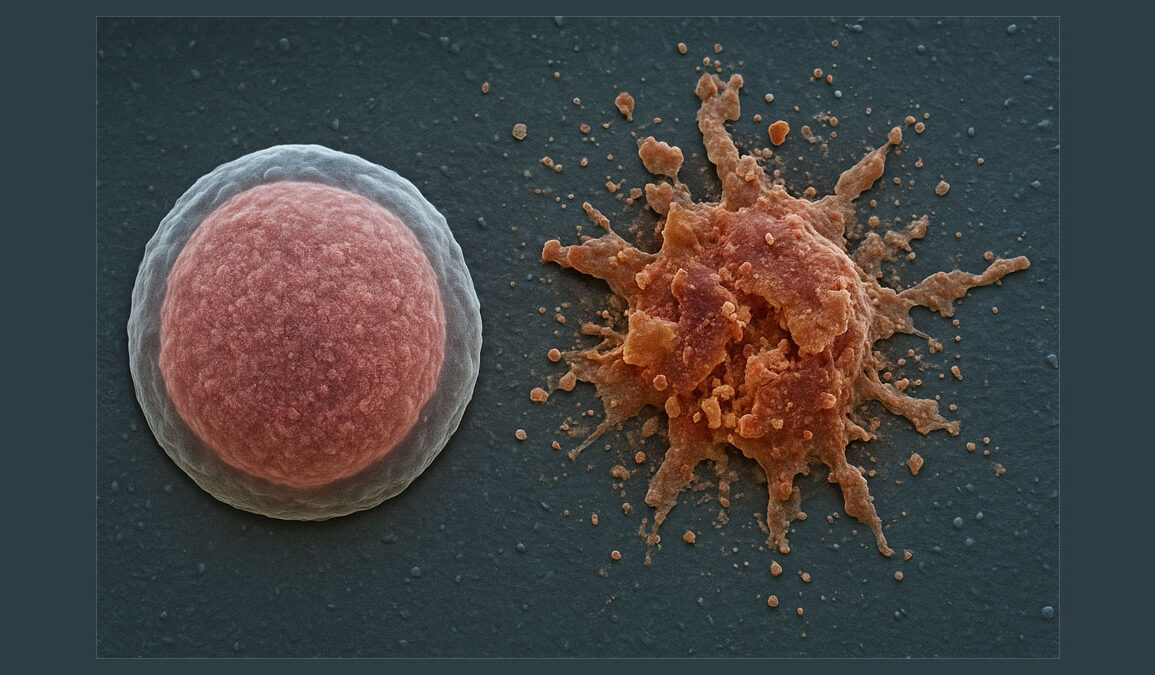
Necrosis is a messy and uncontrolled way that cells die. Unlike the normal, healthy death of old or damaged cells, called apoptosis, necrosis is sudden and catastrophic. Cells essentially burst open, spilling toxic materials into nearby tissues. This leads to inflammation and even more cell death, creating a chain reaction that damages organs.
According to Dr. Carina Kern, CEO of the biotech company LinkGevity and lead author of a study published in Oncogene, “Necrosis has been hiding in plain sight. It’s more than an endpoint — it’s a major cause of biological decline.”
How Necrosis Drives Aging
As we age, our cells become more vulnerable to necrosis. When necrosis occurs, it causes a breakdown of healthy tissue and triggers inflammation. This snowball effect is thought to underlie many diseases of aging, including kidney disease, heart disease, Alzheimer’s, and Parkinson’s.
Dr. Keith Siew from the UCL Centre for Kidney & Bladder Health explained, “When enough cells die, then tissues die, and then we die. The question is what would happen if we could pause or stop necrosis.”
Necrosis is especially damaging in organs like the kidneys. By the age of 75, almost half of people have some form of kidney disease, and necrosis may be the key driver of that decline.
Can We Stop Necrosis?
The big question is how to stop necrosis from happening. Necrosis occurs when the balance of calcium in a cell is lost. Normally, calcium levels outside a cell are thousands of times higher than inside. But when this balance fails, calcium rushes in like a short circuit and the cell self-destructs.
Past attempts to block calcium entry into cells haven’t been successful in diseases like stroke. But researchers think new ways to intervene could finally help. Dr. Kern believes that if scientists can find a way to stop necrosis – even temporarily – it could halt the destructive cycles that lead to disease and aging.
The Potential Payoff
The payoff of this research could be huge. If necrosis can be paused or stopped, it might allow tissues to heal and even regenerate. This could open new doors for treating cancer, cardiovascular disease, and neurodegeneration.
It might also help astronauts. In space, astronauts’ bodies age faster because of low gravity and cosmic radiation. Dr. Siew’s research has shown that the kidneys are a bottleneck for long-term space missions, and necrosis is a key part of that problem. If necrosis could be stopped, it might protect astronauts and improve their health during long missions.
Professor Damian Bailey from the University of South Wales said, “Targeting necrosis could transform longevity on Earth and push the frontiers of space exploration.”
A New Frontier in Medicine
For a long time, necrosis was seen as a natural and unavoidable part of biology. But this new research suggests it’s more than that. It might be the main reason our bodies lose resilience and break down as we age.
As Dr. Kern says, “Necrosis remains one of the last frontiers in medicine — a common thread across aging, disease, space biology, and scientific progress itself.”
With new understanding and potential treatments, scientists hope to slow aging and improve health for people on Earth and in space.
HNZ Editor: If it turns out we can get a handle on this, it is a great breakthrough, could be that we can strengthen cell walls, or just efficiently clean up after a necrosis event. A single point of emphasis would quickly developing extended life.