


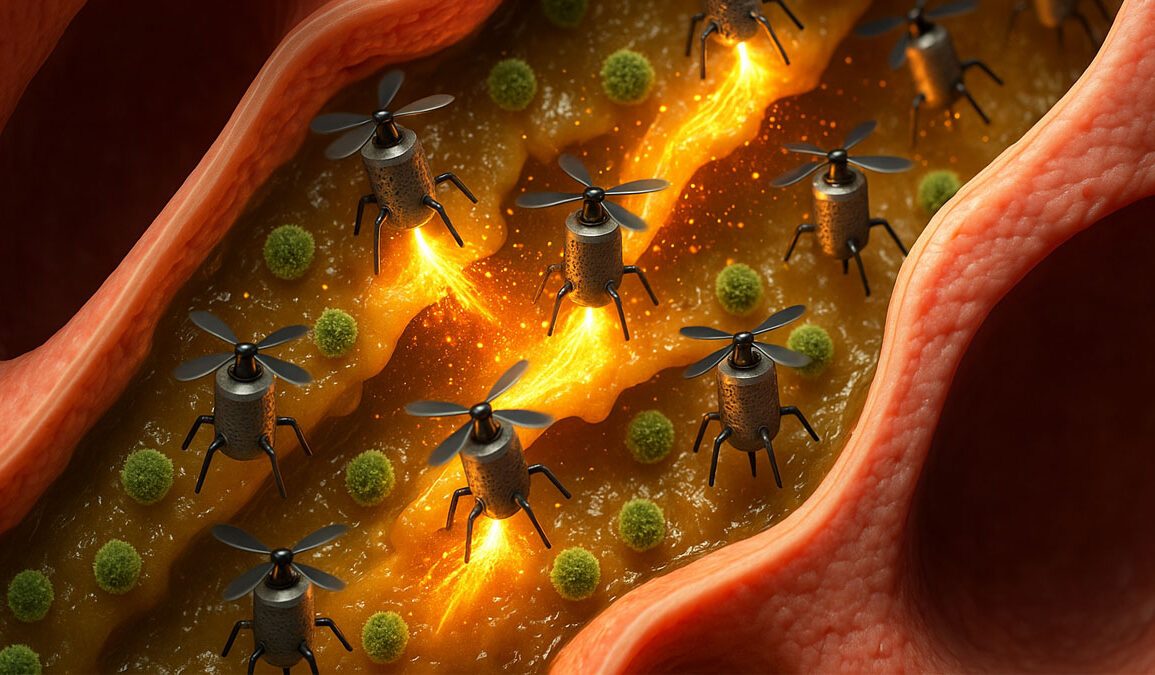
Imagine having your clogged sinuses cleared out by thousands of microscopic robots. That scenario may soon be real, thanks to groundbreaking research from scientists in China and Hong Kong.
The idea is simple in theory but highly advanced in practice. The robots, each smaller than a speck of dust and only a fraction of the width of a human hair, are injected through the nostril into the sinus cavity. A catheter guides them to the infection site, where magnets and light control their movement and activity.
Once in place, the robots heat up and trigger chemical reactions that break down thick bacterial layers, also known as biofilms. These stubborn layers often block antibiotics and make chronic sinus infections difficult to treat. The robots generate reactive oxygen molecules that damage bacterial cell walls and kill the germs directly.
After completing their mission, the robots can be flushed out of the body naturally, often expelled into a tissue when the patient blows their nose.
This technology comes from a collaboration of scientists at the Chinese University in Hong Kong and universities in Guangxi, Shenzhen, Jiangsu, Yangzhou, and Macau. Their findings were published in the journal Science Robotics.
In animal trials, the micro-robots successfully eradicated sinus infections in pigs and rabbits without causing visible tissue damage. According to the researchers, the results show the potential for a drug-free treatment that could reduce reliance on antibiotics.
Professor Sylvain Martel, who directs the Nano Robotics Laboratory at the Polytechnique de Montréal, compared the technology to a rocket you can steer with a magnetic field. He explained that the main advantage is precision targeting. Instead of taking medicine that circulates through the entire body, these robots deliver therapy exactly where it’s needed.
“It’s like a rocket that you can direct with a magnetic field,” Martel said. “Instead of taking medicine that goes into the bloodstream and a small quantity goes to the right location, you can target.”
Dr. Andrea Soltoggio, a specialist in artificial intelligence at Loughborough University, agreed that the idea may unsettle some people at first. However, he emphasized that the robots are designed for a very specific purpose: destroying bacteria in hard-to-reach areas.
“The public may be suspicious about non-biological objects like nano-robots being inserted into our bodies,” Soltoggio noted. “But it is important to look at what nano-robots are designed for. In this case, we see an example of a targeted intervention to reduce or eradicate an infection with a localised action.”
While the research has produced exciting results, it still faces major hurdles before becoming a treatment for humans. One concern is making sure none of the robots remain in the body after treatment. Another is convincing the public that inserting micro-robots isn’t dangerous or invasive.
Despite these obstacles, experts believe clinical use could be possible within five to ten years. The technology might not only treat chronic sinus infections but could also target bacterial infections in the bladder, intestines, and respiratory tract.
The researchers believe their approach offers clear benefits: a non-invasive, drug-free method to attack infections that antibiotics can’t easily reach.
As more advanced versions of these micro-robots are developed worldwide, including those designed to travel through the bloodstream, medicine may be on the verge of a major transformation. In the near future, a trip to the doctor for a stubborn sinus infection could mean a prescription not for pills but for a precise swarm of microscopic machines ready to clear the way.