

Artificial intelligence has made remarkable progress in the world of medicine. From reading X-rays to summarizing patient records, AI systems are already proving to be valuable assistants in clinical settings. In a recent study conducted by Penda Health in Nairobi, Kenya, doctors who used a tool called AI Consult made significantly fewer diagnostic and treatment errors—16% and 13% fewer, respectively—than those who didn’t. The AI system worked behind the scenes, alerting doctors to possible mistakes in real time, but left all final decisions up to the clinician.
This kind of partnership is becoming more common. Hospitals and clinics around the world are experimenting with AI to reduce workloads, improve accuracy, and make healthcare more accessible. AI tools can already detect cancer in radiology scans, flag risky drug interactions, suggest rare diagnoses, and even summarize patient histories—tasks that traditionally take doctors hours to complete.
The Push to Replace Doctors
Some believe this is just the beginning. Microsoft co-founder Bill Gates made headlines earlier this year by predicting that AI will replace most doctors, teachers, and even mental health professionals within a decade. “With AI,” Gates said, “great medical advice will become free and commonplace.” He imagines a future where intelligent systems do most of the heavy lifting, from diagnosing illness to guiding treatment, at a fraction of today’s cost.
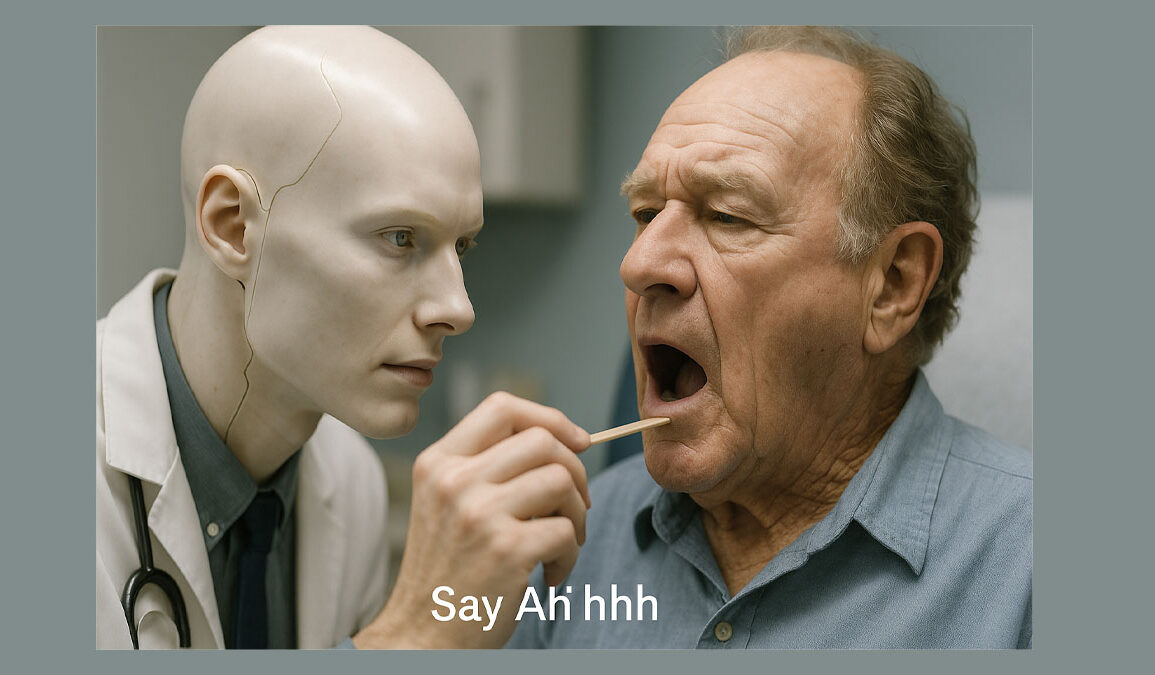
Dr. Mehmet Oz, now head of the Centers for Medicare and Medicaid Services, echoed that idea. In his first meeting with staff, Oz said that AI-based visits could cost just $2 per hour compared to $100 for human doctors. “Patients may prefer an AI avatar,” he reportedly said.
Advocates argue that with a global shortage of physicians, especially in low-income areas, AI could deliver quality care where no doctor is available. They point to AI’s success in passing the U.S. medical licensing exam and its ability to outperform humans in fields like pathology and dermatology. If AI can diagnose faster and cheaper—and in some cases, more accurately—why not use it?
Why Many Say AI Will Never Replace Doctors
Despite the hype, most experts agree that AI is not about to take over the doctor’s role entirely. Jesse Pines, an emergency physician and expert on healthcare innovation, argues that medicine is about far more than data. “AI is becoming medicine’s smartest assistant,” Pines says, “but it won’t replace what physicians actually do—at least not anytime soon.”
Doctors do more than analyze charts. They interpret complex, messy information, make ethical decisions, perform hands-on procedures, and most importantly, connect with patients. As Pines puts it, “Radiologists coordinate care. Dermatologists perform surgeries. Pathologists advise teams. None of these hands-on tasks can be delegated to an AI.”
Empathy, too, matters. A 2011 study found that patients with empathetic doctors had better control over chronic diseases like diabetes. Machines can’t replicate a comforting touch or a deeply human conversation when delivering bad news.
There’s also a trust issue. A recent survey found that Americans are less likely to see a doctor who uses AI. Even when told that AI was used for administrative purposes, patients perceived those doctors as less competent, less trustworthy, and less empathetic. And when it came to complex care, trust in AI dropped even more.
What Doctors Are Actually Doing with AI
Rather than replacing doctors, most health systems are using AI to support them. At Penda Health, for example, the AI copilot was built into the existing system so doctors wouldn’t have to change their workflow. It flagged missed diagnoses like iron-deficiency anemia, giving doctors a chance to reconsider before finalizing treatment plans. Over time, doctors who used AI Consult triggered fewer alerts, suggesting that the tool helped them learn and grow.
Stanford’s Dr. Jonathan Chen, who has researched AI in clinical settings, says that doctors who know how to use AI will outperform those who don’t. But he’s quick to add that AI still needs to be supervised. “You should hope AI gets in here,” he says. “We’re drowning in paperwork. Our patients are waiting months. We need help.”
AI is also being used for things like documenting notes, summarizing research, and guiding early diagnoses. OpenEvidence, for example, is a platform that helps doctors quickly access the latest clinical studies. In emergency rooms, AI is helping to flag heart attacks and strokes faster than ever before. These tools are not making decisions—they’re enhancing them.
What the Polls and the Public Are Saying
Public opinion is mixed. A 2023 survey found that 64% of patients would trust an AI-generated diagnosis over a human one for simple issues. But that number drops when the health problem becomes more serious or emotionally complex. Another recent study showed that patients were significantly less likely to make an appointment with a doctor if they were told that doctor used AI in any form—even for basic tasks like scheduling or billing.
The perception gap is real. Many people still think of AI as cold, robotic, or even dangerous, especially when it comes to life-or-death situations. And with good reason: AI systems have made mistakes, denied insurance claims, and been shown to reflect racial and socioeconomic biases based on the data they were trained on.
Steven Waldren of the American Academy of Family Physicians puts it this way: “There are two big unknowns: that the knowledge of medicine is beyond the capacity of the human brain, and that AI can actually result in more empathy by reducing burdens on physicians.”
The Path Forward: Doctors with AI, Not Doctors or AI
The future of medicine will likely be one of collaboration, not competition. AI will take on repetitive, data-heavy tasks. It will help doctors catch errors, suggest better treatments, and ease administrative burdens. But it will still be the doctor who makes the final call, talks to the patient, and bears the responsibility for care.
The challenge is implementation. AI tools must be trained on diverse data, integrated into real-world systems, and taught to medical professionals in ways that fit into their daily routines. Regulation, too, must evolve to answer tough questions about liability, privacy, and trust.
As Dr. Chen puts it, “AI is not going to replace anybody, but people who learn how to use it will replace those who don’t.” The goal is not to remove the human element from healthcare—it’s to empower it.
Final Thoughts
Bill Gates may envision a future where we no longer need humans “for most things,” but in healthcare, that future isn’t here yet. AI has already transformed how doctors work, and it will continue to do so. But doctors do more than solve medical puzzles. They touch lives. They comfort. They inspire trust.
AI can be a powerful partner. But for now, and for the foreseeable future, it won’t be replacing your doctor—it’ll be sitting beside them.