

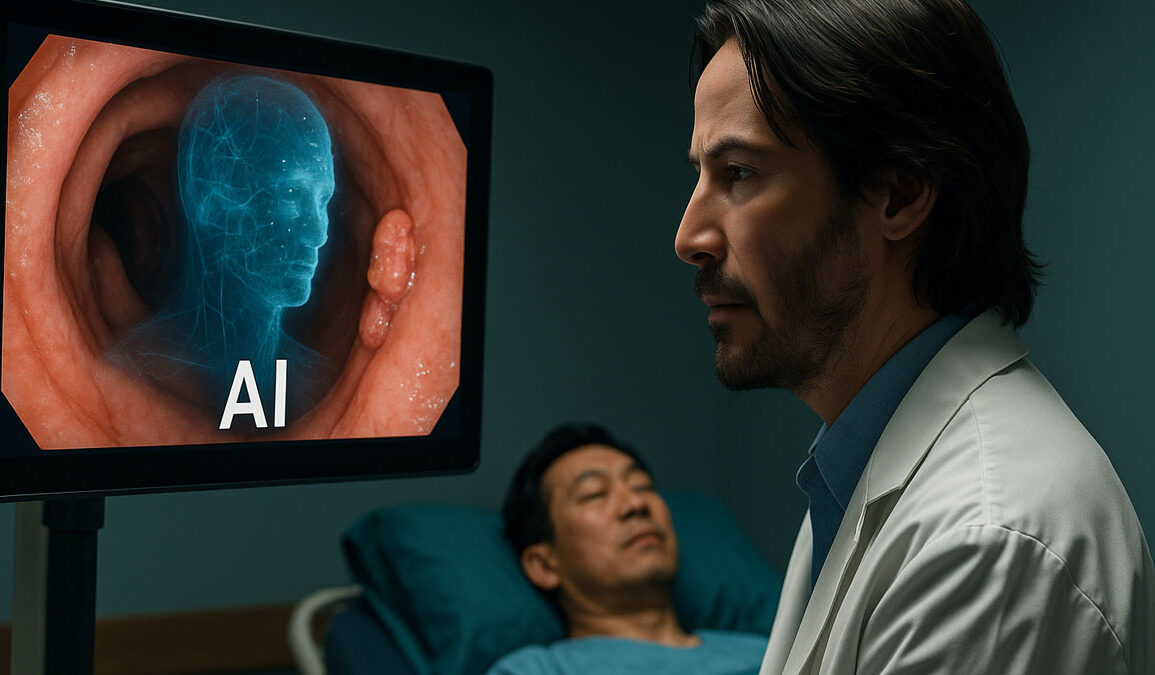
Artificial intelligence has been celebrated as a breakthrough in medicine, but a new study suggests it may come with an unintended consequence. Researchers found that doctors who use AI tools during colonoscopies actually become less effective at detecting colon cancer when those tools are not available. The findings raise questions about how much physicians should rely on technology and whether their own diagnostic skills are eroding.
Who conducted the research
The study was carried out at four endoscopy centers in Poland as part of the ACCEPT trial, a project launched in late 2021 to evaluate AI in colonoscopy for cancer prevention. It followed 19 highly experienced doctors, each with more than 2,000 colonoscopies under their belts. The results were later published in The Lancet Gastroenterology and Hepatology and are now drawing attention worldwide.
Professor Yuichi Mori of the University of Oslo, one of the study’s authors, explained that this work might provide the first real-world evidence that routine AI use can negatively impact physicians’ skills. He described it as a case of “deskilling,” where doctors unconsciously lose sharpness because of technology.
The Study
Between September 2021 and March 2022, 1,443 patients underwent colonoscopies at the participating centers. Some procedures were done with AI assistance, while others were performed without it. Researchers compared tumor detection rates, also known as the adenoma detection rate, before and after AI tools were introduced.
The results were troubling. Before AI was used, detection rates stood at 28.4 percent. After AI was introduced, when doctors performed procedures without the technology, the rate dropped to 22.4 percent. This represents a 6 percent absolute drop, or about a 20 percent relative decline.
Dr. Harvey Castro, an emergency physician and AI specialist in Texas, said the difference could affect “thousands of patients.” He explained, “Even small changes in adenoma detection can shift cancer outcomes. A reduction of a few percentage points is meaningful at a population level.”
Why skills may decline
The researchers suggested that continuous exposure to AI causes doctors to unconsciously rely on the tool’s cues instead of their own judgment. Over time, this can reduce their focus, motivation, and responsibility during independent procedures. Even seasoned physicians with years of practice were affected.
Dr. Omer Ahmad, a gastroenterologist at University College Hospital in London, noted that the effect could be even more serious for younger doctors who are still in training. If they learn to depend on AI too early, they may never fully develop the observational skills needed for high-quality endoscopy.
Commentators are divided on what this means for the future of AI in medicine. Some argue that this study highlights a dangerous side effect of rapid adoption. “Although AI continues to offer great promise to enhance clinical outcomes, we must also safeguard against the quiet erosion of fundamental skills,” Ahmad warned.
Others say the solution is not to abandon AI but to use it more carefully. Castro stressed that AI should be integrated “wisely” to support doctors rather than replace them. “Medicine is still a human profession,” he said. “The doctor’s eye, judgment, and pattern recognition remain irreplaceable.”
The issue extends beyond colonoscopies. A 2025 study from MIT found that students who relied heavily on AI writing tools showed less cognitive engagement, suggesting that overuse of AI can dull critical thinking skills in many fields. In medicine, where lives are at stake, the consequences are especially concerning.
Researchers and doctors agree that a balanced approach is necessary. Suggested strategies include alternating between AI-assisted and manual procedures, tracking detection accuracy regularly, and reinforcing independent skills through ongoing training.
AI will remain a powerful tool in healthcare, offering new ways to detect disease and save lives. Yet this study serves as a stark reminder: technology can make doctors better, but it can also make them worse if it replaces rather than complements human expertise. The challenge now is to find the balance between innovation and skill, so patients receive both the benefits of AI and the sharpest possible human care.