

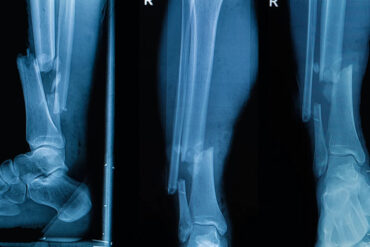
Breaking a bone may soon no longer mean long recoveries or invasive surgery. Scientists in China have developed a new adhesive, known as Bone-02, that can heal fractures in just three minutes without screws, plates, or metal implants.
The research team from Zhejiang Province drew inspiration from an unexpected source: oysters. These shellfish cling firmly to wet surfaces despite waves and water currents. Lin Xianfeng, associate chief orthopedic surgeon at Sir Run Run Shaw Hospital and the lead researcher, explained that his idea came from observing this natural phenomenon. By mimicking how oysters attach themselves underwater, his team created a glue that can bond bones even in blood-rich surgical environments.
What Makes Bone-02 Different
Unlike traditional bone cements or fillers, Bone-02 functions as a true adhesive. It creates a bond in two to three minutes, strong enough to hold fractured bones with a maximum force of over 400 pounds. Laboratory tests measured a shear strength of about 0.5 MPa and compressive strength around 10 MPa. Even more importantly, the glue is bioabsorbable. As the bone heals, Bone-02 naturally dissolves inside the body, removing the need for a second surgery to take out hardware.
More than 150 patients have already been treated with Bone-02 in laboratory and clinical trials. Surgeons reported that procedures that once required hours of work with steel plates and screws could now be completed in minutes. According to results, the glue worked reliably even in complex or blood-rich fractures, and no major safety concerns were reported.
Potential Impact on Medicine
If adopted widely, Bone-02 could reduce surgery times, cut infection risks, and speed up recovery for patients. The adhesive could be especially useful in regions with limited access to advanced surgical facilities, as it simplifies operations and avoids costly follow-up procedures. Experts suggest it may represent a long-sought breakthrough in orthopedic surgery, offering an alternative to the metal implants that have dominated fracture treatment for decades.
While the results are promising, Bone-02 is still in the early stages of wider adoption. Past attempts to create bone adhesives, dating back to the 1940s, often failed due to biocompatibility issues. Long-term safety data and large-scale studies will be necessary before it becomes a standard treatment worldwide. Surgeons will also need training to integrate the new material into established practices.
Global Times described the development as a “game-changer,” while other outlets noted that it may finally solve one of surgery’s oldest challenges: repairing shattered bones quickly and safely. Lin himself recalled watching complex fracture surgeries during his residency in 2016 and realizing how much better patient outcomes could be with a simpler solution. His team’s work is now being viewed as the culmination of decades of attempts to solve a problem that has frustrated doctors for generations.
A New Era of Bone Repair
Bone-02 is still being tested, but early signs point to a future where a broken bone can be fixed in minutes rather than months. By combining inspiration from nature with modern medical science, Chinese researchers may have created a tool that changes how fractures are treated across the world.