


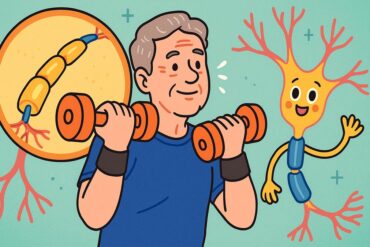
For decades, people assumed aging muscles simply wore out. They shrank, weakened, and slowly lost their ability to perform the movements that once felt effortless. But new work by researcher Zdeněk Šípek suggests that the real story may begin much earlier and much deeper in the body. According to Šípek, age related muscle loss might not be driven by the muscle tissue itself. Instead, he argues that the nervous system slowly degrades first, and the failing nerves trigger the muscle decline that follows.
Šípek, who writes extensively about neuromuscular aging and exercise science, bases his views on a growing body of research, including the large CLINIMEX Exercise cohort study. His central claim is striking. Muscle power declines because the nerve supply that controls muscle fibers is breaking down, and muscle wasting is largely a downstream effect of that neurological decay.
What Šípek Says About Power, Longevity and the Nervous System
Šípek highlights a simple but powerful idea. The ability to produce force quickly is far more important for long life than sheer strength. Power is what lets someone rise from a chair, catch themselves during a slip, or climb stairs without hesitation. And declining power seems to reflect the health of the nerves as much as the health of the muscles.
He points to the CLINIMEX dataset, which followed nearly four thousand adults aged forty six to seventy five for over a decade. In that group, low muscle power predicted mortality better than any measure of strength. Men with the lowest power measurements were almost six times more likely to die than those with the highest power. Women with the lowest power scores faced nearly seven times the risk.
To Šípek, these numbers tell a story about nerve failure. The velocity component of muscle power falls fastest with age, and the loss of coordination and reaction time mirrors changes taking place in the nervous system. When nerves begin to malfunction, muscles soon follow.
Why Nerve Decline May Be the True Driver of Muscle Loss
Much of the traditional thinking about aging muscle has revolved around sarcopenia. This is usually defined as a direct loss of muscle mass and strength. But Šípek argues that sarcopenia makes more sense as a neurological condition.
Human motor units are constantly remodeling themselves. Nerves that die leave behind muscle fibers that are temporarily disconnected. Other neurons attempt to rescue those fibers by sprouting new branches and reconnecting them. Early in life this rescue system works well, but after age sixty the nerves begin to fall behind. More fibers lose their nerve supply than are reinnervated. Over time this results in fewer motor units, fewer fibers, and a shrinking ability to produce rapid force.
This cascade explains the pattern seen in older adults. Fast twitch fibers, which depend heavily on crisp neural signaling, shrink by as much as fifty percent. Slow twitch fibers shrink too, but far less. Muscle mass declines by up to forty percent between ages twenty and sixty. By the late eighties, people may have half as many fibers as they did in youth.
Even the neuromuscular junction, the tiny communication link between nerve and muscle, becomes fragmented and unreliable. That loss of clean signaling contributes to weakness, slower reaction time, and reduced coordination.
In short, the nervous system falters first, and muscle loss becomes its visible aftermath.
Other Research Linking the Nervous System to Muscle Aging
Šípek’s ideas align with a broad set of findings in the field of neuromuscular aging.
Studies show that motor neuron counts in the spinal cord drop by about twenty five percent over the adult lifespan. Research on aging neuromuscular junctions captures clear structural damage, from shrinking nerve terminals to widening gaps in the synapse. Scientists have also observed fiber type grouping, where rescued fibers take on the identity of the surviving motor neuron. This slows contractile speed and reduces the explosive ability of the muscle.
Together, these observations strengthen Šípek’s theory that the nervous system is the real bottleneck in healthy aging.
Can Exercise Strengthen the Nervous System
An important question follows from this insight. If nerves drive muscle decline, can exercise protect them?
There is good evidence that the answer is yes. Power based training that emphasizes speed, coordination, and rapid movement appears to stimulate the nervous system in ways that heavy slow lifting does not. Exercises that demand balance, reaction time, and precision help maintain the neural circuits responsible for firing patterns and motor control.
Šípek argues that older adults should shift their training toward movements that challenge coordination and velocity instead of focusing only on strength. This includes plyometrics, fast but safe resistance movements, agility drills, and dynamic full body routines. Programs that vary movement patterns, similar to P90X3, may help maintain both muscular and neural adaptability.
How This Information Might Be Used to Protect Nerve Health
If nerve loss drives muscle loss, then preventing neural decay becomes a central strategy for healthy aging. The implications are wide.
People may benefit from screening tests that measure muscle power, not just grip strength. Clinicians may begin recommending coordinative training, not just strength training. And researchers may focus on therapies that target the neuromuscular junction, motor neuron survival, or reinnervation efficiency.
Other possibilities include improving nerve health through nutrition, electrical stimulation, improved sleep, and better management of metabolic conditions that harm neurons.
While there is no single solution yet, the logic is clear. Strength alone cannot preserve function in later life if the nervous system is failing. Protecting the nerves may be the most promising path to protecting the muscles and, by extension, preserving independence and longevity.