
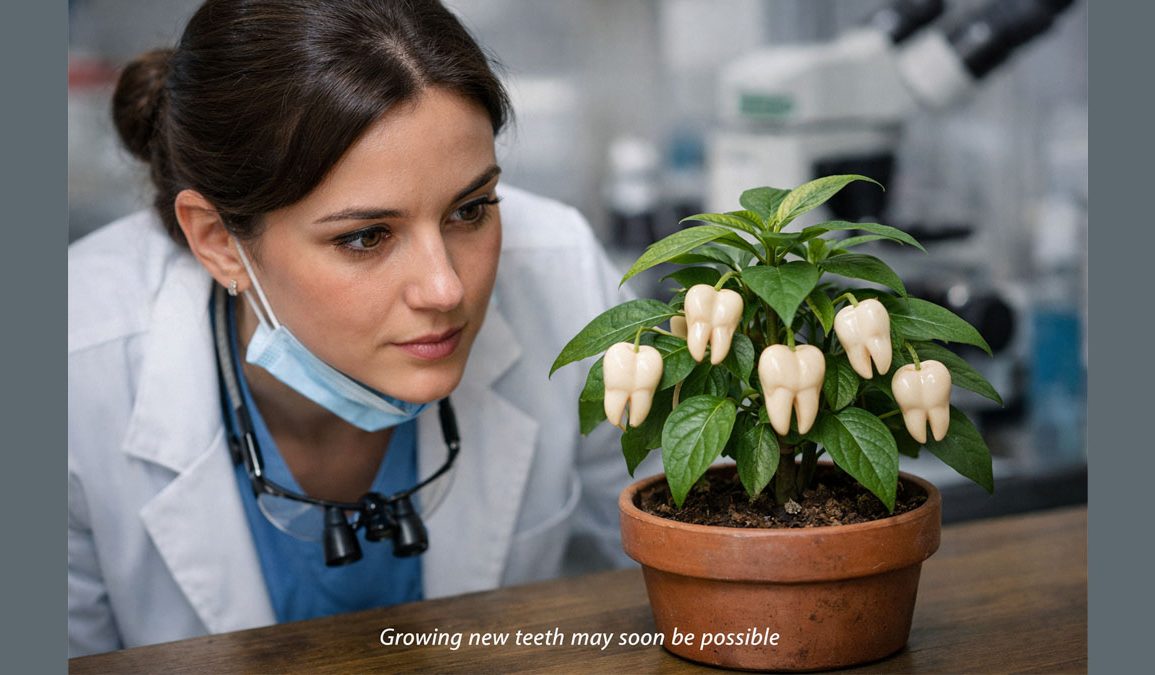
We have covered this a couple of times just this year, but the development of treatments appear to be moving at lightning speed. For the first time in history, scientists believe humans may soon be able to naturally regrow lost teeth. This breakthrough is moving from theory to reality in Japan, where researchers have begun human clinical trials on a drug designed not just to repair missing teeth, but to activate the body so it grows new ones. If the trials succeed, experts say a tooth-regrowing treatment could be available within about four years, around 2030. That would completely change dentistry, shifting it from mechanical replacement to true biological regeneration.
Humans normally develop only two sets of teeth. We grow baby teeth, lose them, and then develop permanent adult teeth. Once the adult set forms, the biological program that controls tooth creation shuts off. Unlike sharks and other animals that continually grow new teeth throughout life, humans have no natural way to restart that system. Tooth formation is controlled by a complex interaction of cells and signaling pathways such as BMP and Wnt during early development. When this process finishes in childhood, the “switch” is turned off for good. Until now.
The Science Behind Regrowing Teeth
The Japanese research centers on a key protein called USAG-1. This protein acts as a brake, preventing new teeth from forming. Scientists discovered that if they block USAG-1, they can unlock dormant tooth buds that still exist in the mouth and trigger them to develop into fully formed teeth. The experimental treatment uses an antibody to neutralize USAG-1, allowing important BMP signaling to operate again. In previous animal studies using ferrets, mice, and dogs, blocking this protein successfully triggered new tooth growth with no serious side effects. Researchers describe it as releasing a biological restriction that has been in place since childhood.
This groundbreaking work is being led by scientists in Japan at Kyoto University and Kitano Hospital in Osaka. Katsu Takahashi, head of dentistry at Kitano Hospital, has long pushed toward a permanent cure for tooth loss. He explained that people suffering from missing teeth have waited for something beyond dentures and implants, and expectations are high. Human trials officially began in late 2024, marking the first time in history that a tooth-regrowth drug has been tested in people.
A Possible Treatment Within Four Years
If trials continue to succeed, the Japanese team believes the drug could be available around 2030. That means we are possibly just four years away from a world where instead of implants, bridges, and dentures, people may grow new natural teeth. Analysts describe this as a revolution in dentistry. Instead of artificial replacements that wear out, fail, or never fully feel natural, patients would have real biological teeth again.
The first clinical trial involves around 30 adult men between ages 30 and 64 who are each missing at least one tooth. Over about 11 months, they will receive intravenous doses of the medication. The purpose of this early phase is to test safety and see whether biological responses begin. If this succeeds, the next phase will involve young children ages 2 to 7 who are born missing multiple teeth. Children are a key focus because they still have more active dental progenitor cells. Researchers hope eventually the drug can help anyone who loses a tooth, not just people with congenital dental problems.
Japan may be the first to test in humans, but the race toward tooth regeneration is global. Scientists in Korea recently identified how specific cells know when and where to form teeth, guided by signaling molecules like Wnt and BMP. Researchers in Tokyo discovered distinct stem cell populations responsible for forming tooth roots and surrounding bone, revealing how tooth and jaw structures coordinate growth. Teams in the United States and Europe are also working with stem cells, engineered scaffolds, and enamel regeneration technologies. Together, this growing body of research is building the scientific foundation needed to make full biological tooth restoration possible.
Millions of people worldwide lose teeth because of injury, age, or disease. Dentures and implants help, but they cannot truly replicate nature. They require surgery, can fail, and never fully recreate the living biology of a tooth. A treatment that allows the body to do what seemed impossible changes everything. It would give people real teeth again, connected to bone, responsive to the mouth, and biologically alive.
For generations, losing teeth has meant living with artificial replacements and permanent dental compromise. Now, scientists believe that may soon change. With human trials underway, growing new teeth is no longer science fiction. It is becoming medical science, and if successful, it could make tooth loss a temporary condition instead of a lifelong problem.