

A growing class of startup founders and business leaders now treats sleep like a competitive advantage. Nicholas Flanders started optimizing his sleep during stressful funding rounds because “the stress…was having an impact on my sleep.” Now he uses what sleep obsessives call a sleep stack: tools that track, tune, and protect sleep so he wakes up more rested and less groggy.
The mindset is simple: if sleep drives your energy, mood, and decision-making, then improving it is worth real money and real effort. Somnee’s backers put it even more bluntly. Vinod Khosla calls sleep “the cheapest, most underused longevity drug we have.” Marc Benioff says enhanced sleep can improve “happiness, energy, and purpose,” and even help leadership and compassion.
The demand is not just vanity or biohacking. Nearly one in three adults suffer from poor sleep, ranging from insufficient deep sleep to insomnia. More broadly, more than 60% of adults experience poor sleep quality. That comes with real costs: researchers estimate poor sleep contributes to the loss of 44 to 54 working days per year, and about a one percent reduction in global GDP.
That is why sleep tech is exploding into a massive business category. Somnee describes a $91.4 billion sleep aid market. And at the personal level, people like Flanders track how they feel against measurable changes. After adding temperature control, he reports averaging 15 to 20 minutes more deep sleep per night, about a 25% increase, and says his sense of being rested correlates strongly with deep sleep.
The rise of “smart pajamas” and what makes them different
Most sleep products either improve comfort and environment, or they track sleep indirectly. Smart pajamas aim at something more clinical and specific: monitoring disordered breathing and sleep states at home without sticky patches, bulky equipment, or a sleep clinic visit.
A University of Cambridge team developed washable, comfortable smart pajamas with printed fabric sensors that detect tiny skin movements to track breathing, even when worn loosely. Their lightweight AI model, SleepNet, identifies six sleep states including nasal breathing, mouth breathing, snoring, teeth grinding, central sleep apnoea, and obstructive sleep apnoea, with 98.6% accuracy. The goal is practical: comfortable enough for nightly use, accurate enough to produce meaningful information you can discuss with your doctor.
Sleep Tracking as a Status Symbol
Sleep tracking has become status-symbol common. Jonathan Rosen jokes you can barely attend a New York finance or media event without seeing “the glint of a thousand Oura Rings.” Yet the most competitive users are also learning the downside: too much data can backfire. Rosen switched from Oura to a Garmin watch because Oura’s readiness score could “psyche you out for the day.” Bryn Ferris avoids that trap by checking his Whoop data a few days later, so he stays informed without getting obsessed.
The best stacks are not just about gadgets. They are layered defenses: temperature, light, noise, breathing, and routine. Matthew Walker, the sleep researcher and author of “Why We Sleep,” recommends using tracking data as a guide for patterns like irregular timing, late caffeine or alcohol, and shortened sleep. He also reminds people to keep the bedroom cool and sleep on a consistent rhythm.
The 10 most popular sleep tech items and how they help
- Temperature-controlled bed cover (Eight Sleep Pod)
This is the centerpiece of many sleep stacks because overheating can wreck sleep. The cover contains tiny capillaries of heated or cooled water to regulate bed temperature through the night. Jason Marder says it “instantly had a positive impact,” and his overheating “just stopped happening.” Flanders reports 15 to 20 minutes more deep sleep per night. - Sleep ring tracker (Oura Ring 4)
A ring tracker monitors sleep stages and patterns and turns them into daily feedback. Walker uses Oura as a trend tool to spot patterns like shortened sleep or late alcohol, because awareness can change decisions. But some users find the readiness score can affect mood. That is why a few switch devices or limit how often they check. - Smartwatch sleep tracking (Garmin Forerunner 265)
Garmin tracks sleep hours and stages and recommends habits, similar to a ring, but Rosen prefers its tone because it feels less judgmental. For some people, this matters as much as accuracy. If your tracker makes you anxious, it can become a sleep problem itself, so a gentler approach can help. - Fitness strap sleep tracking (Whoop 4.0)
Whoop is popular with people who want sleep data but do not want to obsess nightly. Ferris checks his sleep data a few days later, which helps him stay consistent without spiraling. He uses it to enforce a personal threshold: if he dips below six and a half hours for a few nights, he recommits. - Smart sleep headband with AI neurostimulation (Somnee)
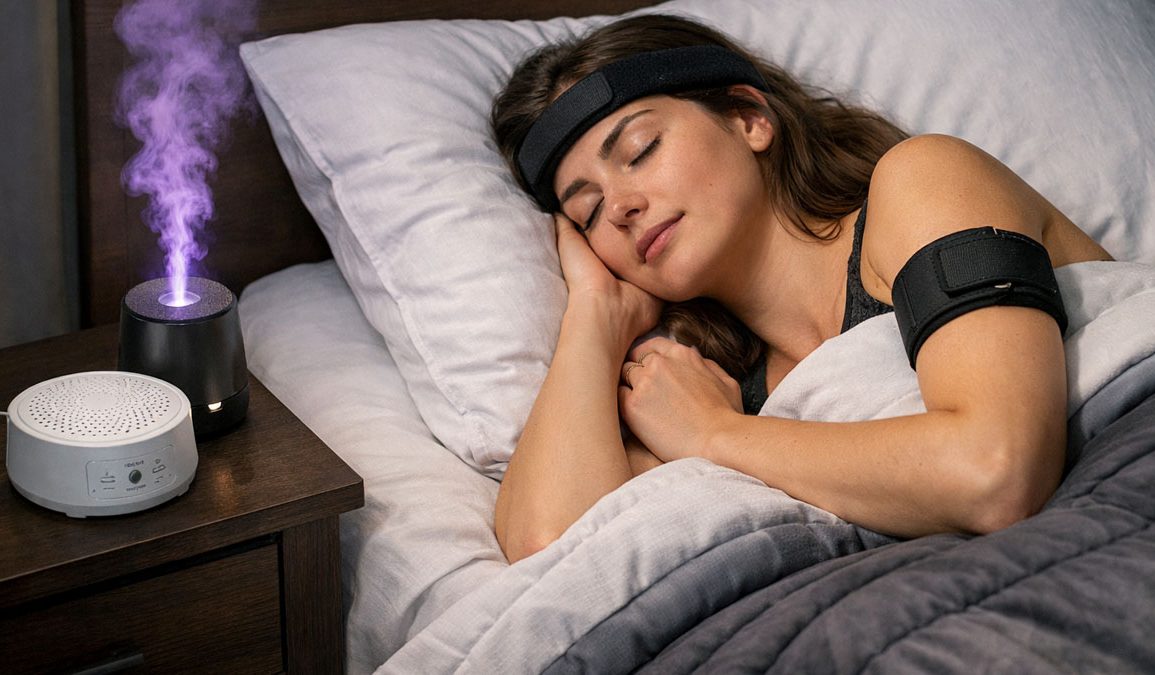
Somnee’s headband maps brain activity using EEG and AI, then delivers gentle, personalized stimulation to guide the brain into sleep. In a published study, it helped users fall asleep twice as fast, stay asleep more than 30 minutes longer, and reduce tossing and turning by a third. It positions itself as an electroceutical approach, not a drug. - Smart pajamas with fabric sensors and lightweight AI (SleepNet concept)
These smart pajamas monitor breathing and sleep states at home without cumbersome clinic equipment. Cambridge researchers say the sensors detect tiny movements in the skin and the AI identifies six states, including sleep apnoea types, with 98.6% accuracy. They are washable and can transfer data wirelessly, supporting long-term monitoring and lifestyle experiments. - White noise machine (Sweet Zzz White Noise Machine)
Noise is a common sleep disruptor, especially when it is sudden. A white noise machine masks external sound by providing non-looping white, pink, or brown noise, plus options like rain or waves. The Sweet Zzz model includes adjustable volume, a timer, and a night light. The point is not entertainment, it is reducing sleep interruptions. - Noise masking earbuds (SoundOff Noise Masking Earbuds)
Some sleepers want noise control without filling the whole room with sound. SoundOff earbuds use pink noise to drown out external noise and are designed to stay in place in different sleep positions. They run without Bluetooth or Wi-Fi, making nightly use simple. This is a targeted solution for people whose sleep is harmed by environmental noise. - Wake-up light and smart alarm (Hatch Restore 3)
The way you wake up shapes how you feel all day, and heavy sleepers often need smarter alarms. A wake-up light mimics sunrise, gradually brightening to support your circadian rhythm rather than shocking you awake. Hatch Restore 3 also includes relaxing sounds for bedtime and a night light. It is built to improve both the falling asleep phase and the waking phase. - Sleep accessories that block light and support relaxation (sleep masks and pillow spray)
Light interferes with circadian rhythm, and blocking it can help your body produce melatonin naturally. Sleep masks create darkness even in imperfect bedrooms. On the relaxation side, pillow sprays use scents like lavender and chamomile to promote calm. Together, these tools aim at a quieter, darker, more soothing sleep environment with minimal effort.
A practical way to think about your own sleep stack
Sleep tech works best when it supports habits rather than replaces them. Use data for trends, not daily self-judgment. Build a simple defense system around temperature, light, and noise. If breathing or sleep apnoea might be involved, that is where newer tools like smart pajamas and advanced wearables could be especially meaningful.
As the sleep professor Walker warns, the goal is improvement, not perfection. Optimize your sleep, but do not lose sleep over it.