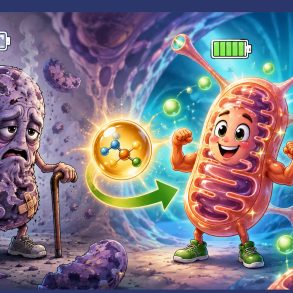


For decades, scientists have searched for the secrets behind unusually long-lived animals. Now, a new breakthrough suggests those secrets may not be locked inside a single species. Researchers have successfully transferred a longevity-related gene from one animal to another, offering a glimpse into how longer, healthier lives might someday be engineered.
What Scientists Are Studying
At the center of this research is a simple but powerful idea. Some animals naturally live longer and resist disease far better than others. Scientists want to understand why, and more importantly, whether those advantages can be transferred.
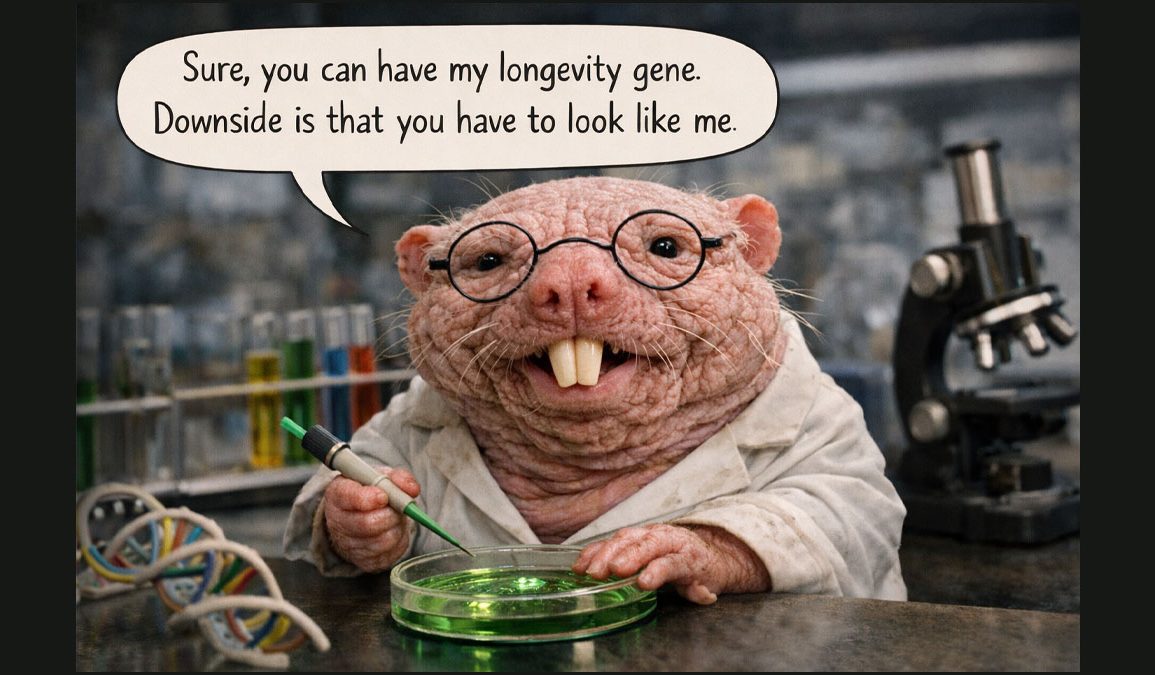
Researchers at the University of Rochester focused on one of the most unusual mammals known to science, the naked mole rat. This animal has an exceptional lifespan and shows remarkable resistance to age-related diseases, including cancer.
Their goal was to identify a specific biological mechanism behind that longevity and test whether it could be “exported” to another species.
The Infamous Naked Mole Rat
Naked mole rats have become a cornerstone of aging research because they combine two rare traits. They live far longer than expected for their size, and they maintain strong resistance to diseases that typically increase with age.
Scientists traced part of this resilience to a substance called hyaluronan, a gel-like molecule that helps regulate how cells communicate, repair damage, and respond to stress.
What makes naked mole rats unique is not just that they produce hyaluronan, but that they produce a very large version of it known as high molecular weight hyaluronan. This form is associated with anti-inflammatory and tissue-protective effects, unlike smaller forms that can promote inflammation.
The Methodology Behind the Experiment
To test whether this longevity mechanism could be transferred, researchers engineered mice to carry the naked mole rat version of a gene called hyaluronan synthase 2, or HAS2.
All mammals have this gene, but the naked mole rat version is tuned to produce unusually large amounts of high molecular weight hyaluronan.
By inserting this gene into mice, scientists were able to directly test whether a single genetic change could replicate some of the mole rat’s longevity advantages.
As Vera Gorbunova explained, “Our study provides a proof of principle that unique longevity mechanisms that evolved in long-lived mammalian species can be exported to improve the lifespans of other mammals.”
How Longevity Was Transferred
The transfer worked by increasing the production of high molecular weight hyaluronan in the engineered mice. This molecule influenced several key biological processes tied to aging.
It reduced chronic inflammation across multiple tissues, which is a major driver of age-related decline. It also improved the integrity of the gut barrier, preventing harmful substances from leaking into the bloodstream and triggering systemic inflammation.
In addition, the modified mice showed stronger resistance to both spontaneous tumors and chemically induced cancers.
Rather than targeting a single disease, the gene appeared to shift the entire biological system toward a healthier aging process.
How Much Lifespan Was Extended
The lifespan increase was modest but significant. The engineered mice experienced about a 4.4 percent increase in median lifespan.
More importantly, they showed clear improvements in health as they aged. This included lower inflammation, better tissue function, and reduced cancer incidence.
In aging research, even small lifespan gains are considered meaningful, especially when paired with broader improvements in health.
Why This Is Considered Groundbreaking
This study represents a major step forward because it demonstrates that longevity traits are not necessarily confined to one species.
Instead, they can be transferred, at least in part, through targeted genetic changes.
The findings support a larger idea that evolution has already solved many of the problems associated with aging. The challenge now is to identify those solutions and apply them in new contexts.
Researchers also observed that similar high molecular weight hyaluronan appears in other long-lived subterranean mammals, suggesting this may be part of a broader evolutionary strategy rather than a one-off discovery.
The scientists emphasize that direct gene transfer is not likely to be the final approach for humans. Instead, they are exploring ways to replicate the same effects through drug-like strategies.
One approach is to increase the production of high molecular weight hyaluronan. Another is to slow its breakdown.
“We already have identified molecules that slow down hyaluronan degradation and are testing them in pre-clinical trials,” said Andrei Seluanov.
One promising candidate is delphinidin, a natural compound found in fruits and vegetables. In early studies, it increased levels of beneficial hyaluronan, reduced cancer cell activity, and suppressed tumor spread in mice.
The Scuttlebutt
Researchers are cautiously optimistic. The results show that some aspects of longevity can be transferred, but they also highlight the complexity of aging.
Not every condition improved. For example, the modified mice did not show protection against age-related hearing loss, suggesting that some tissues may not respond to this pathway.
The broader takeaway is that longevity is not controlled by a single switch. It involves a network of processes that must be carefully balanced.
Still, the implications are profound. This work suggests that the biology of long-lived species can be studied, understood, and potentially adapted to improve human health.
For the first time, scientists are not just observing longevity in nature. They are beginning to move it.