


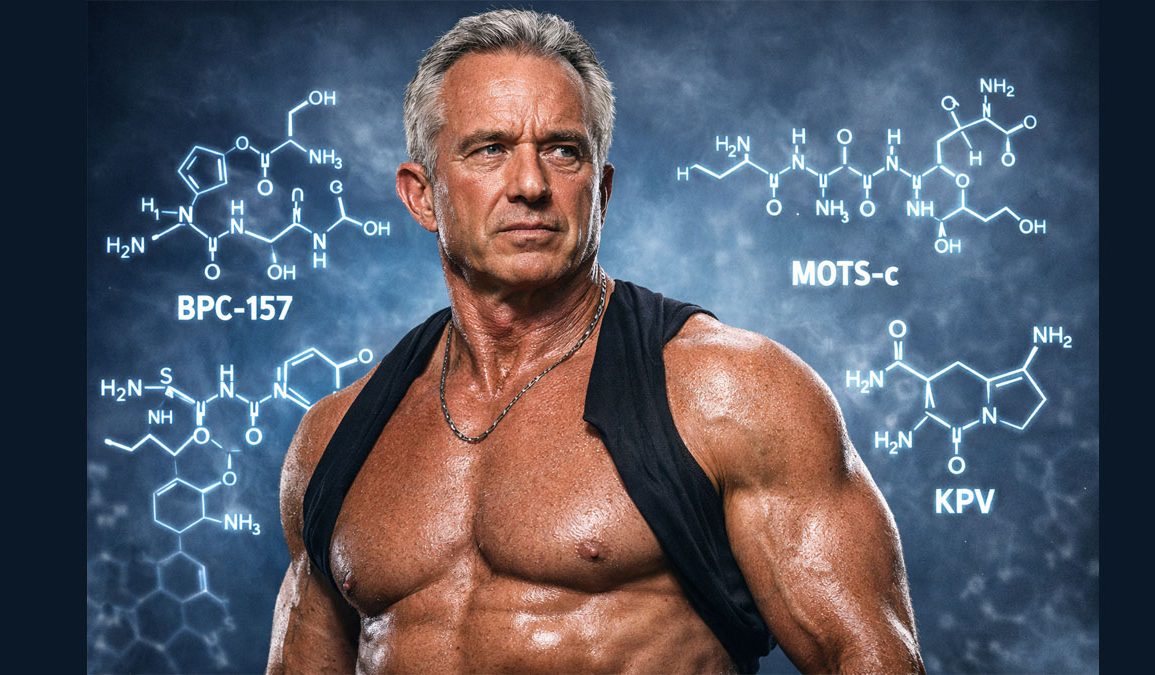
A quiet but potentially major shift is building inside the federal health apparatus. Robert F. Kennedy Jr. is pushing to make peptides more accessible, and the Food and Drug Administration is preparing to revisit restrictions that have kept many of these compounds on the sidelines since 2023.
If the upcoming July review goes Kennedy’s way, a wide range of peptide injections could soon move out of regulatory limbo and into mainstream availability. Supporters see a long overdue correction. Critics see a dangerous loosening of standards. Either way, the outcome could reshape a fast growing corner of medicine.
What do Peptides do?
Peptides are short chains of amino acids, the same building blocks that make up proteins in the human body. They act as signaling molecules, telling the body what to do and when to do it.
Some peptides already play central roles in everyday health. Insulin, for example, is a peptide that regulates blood sugar. Others influence metabolism, tissue repair, immune response, and hormone release.
Modern peptide drugs are typically lab made versions of these natural signals. They are designed to mimic or enhance what the body already does. That is part of their appeal. Instead of bluntly forcing a biological change, they nudge the body in a specific direction.
In recent years, peptides have become a staple among wellness influencers, athletes, and biohackers. People are using them for everything from fat loss and muscle building to faster recovery and anti aging.
Some of the most talked about compounds include:
- BPC-157 for tendon and gut healing
- TB-500 for tissue repair
- CJC-1295 and ipamorelin for growth hormone release
- Semax and selank for cognitive and mood effects
- Epitalon for anti aging
- MOTS-c for metabolic health
Doctors working with these compounds say the results can be striking.
“I have been using peptides such as BPC-157, TB-500 and GHK-Cu in my postoperative patients for about five years,” said Dr. Lisa Cassileth. “In my experience, patients report faster recovery and, interestingly, a range of additional benefits they weren’t necessarily seeking.”
Another physician, Dr. Sue Decotiis, noted that “growth hormone related peptides can be especially helpful for anti aging and maintaining body composition when used appropriately under medical supervision.”
In short, these are not fringe substances with no track record. They are already being used, just not always through official channels.
Most peptides are administered through injections, often subcutaneous, similar to how insulin is delivered. Some are available as nasal sprays or topical formulations, but injections remain the dominant method because they provide more direct and reliable absorption.
This has contributed to their reputation as serious tools rather than casual supplements. They are not just pills you pick up off a shelf. They are closer to medical interventions.
RFK Jr.’s Plan to Open Access
Kennedy has made it clear that he wants to change the current system.
He has called himself a “big fan of peptides” and said he is “very anxious” to make some of them more accessible. His goal is to move them “to a place where people have access from ethical suppliers.”
Behind the scenes, that translates into a push to allow more peptides to be produced by licensed compounding pharmacies. The FDA is expected to consider adding several previously restricted peptides to the list of substances that can be legally compounded.
These include compounds like BPC-157, KPV, TB-500, MOTS-c, semax, and epitalon.
If approved, patients could obtain them through prescriptions filled at state licensed pharmacies rather than relying on informal or overseas sources.
Where People Are Getting Them Now
Despite the restrictions, demand has not slowed down. It has simply shifted.
The current market has been described as a “gray market” or even a “Wild West.” Many products are sold online labeled as “research use only” to bypass regulation. Others are sourced from overseas suppliers, particularly in China.
Doctors acknowledge that this is the real problem.
“The greater concern lies not in the peptides themselves, but in how they are sourced, prescribed and used,” Decotiis said. “Poor quality manufacturing or unsupervised use increases risk significantly.”
In other words, people are already using peptides. The question is whether they will do so in a controlled system or an uncontrolled one.
What Doctors Are Worried About
The medical establishment is not uniformly opposed, but it is cautious, sometimes to a fault.
Concerns fall into several categories:
- Lack of long term clinical data
- Potential contamination or impurities
- Risks like infections or hormone disruption
- Possibility of masking underlying conditions
- Specific worries about growth hormone related peptides and tumor growth
The FDA has also emphasized that compounded drugs should only be used when approved options are not available.
Critics argue that loosening the rules could undermine the traditional drug approval process. As former FDA official Dr. Peter Lurie put it, “The Wild West is about to become wilder. I don’t see why one would take the path of proper drug approval if there is now this less rigorous, alternative path to market.”
That is the core tension. Safety versus speed.
The Case for Moving Faster
Supporters of Kennedy’s approach see the situation differently.
They argue that the current system is too slow, too expensive, and too rigid, especially for compounds that already exist in the human body and cannot easily be patented.
Because many peptides cannot be patented, pharmaceutical companies have little incentive to fund the massive trials required for FDA approval. That leaves potentially useful therapies stuck in limbo.
“Many peptides are unlikely to ever receive FDA approval, not necessarily because they are unsafe, but because the pharmaceutical companies producing them cannot afford the extensive and costly studies required,” Decotiis said.
From this perspective, regulators are blocking access not because the compounds are dangerous, but because the system is not designed for them.
Meanwhile, patients are already experimenting on their own.
The FDA’s July meeting could go several ways. It could approve all, some, or none of the peptides under review.
A broad approval would likely pull much of the market out of the shadows and into regulated pharmacies. A partial approval could create a split system where some compounds are legal and others remain in limbo. A rejection would keep the current gray market intact.
Even if restrictions are eased, most peptides would still not be fully FDA approved drugs. That distinction will continue to matter.
HNZ Editor: RFK definitely has guts and sees the benefits of peptides that have been remarkably effective for quite a while.
And the doctors who are complaining about not having enough data are gutless. Pulling your hair out and shouting that there is not enough data is not science.