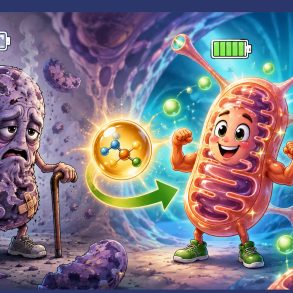



Scientists have found something striking in aging research: older mice that had growth hormone signaling shut down in their fat tissue showed far less brain aging and performed on memory tests almost like young mice. The work suggests that adipose tissue is not just stored energy. It may help control how fast the brain ages.
The findings come from a research team led by Yue Zhang, Rui Ma, and colleagues, in a paper titled Adipose Specific GHR Deletion Attenuates Brain Aging and Cognitive Decline in Aged Mice, first published February 12, 2026.
The researchers focused on the growth hormone pathway, especially the growth hormone receptor, and its relationship to the growth hormone and insulin like growth factor 1 axis, also called the GH and IGF 1 axis.
This system is already well known in aging, and prior work has linked it to brain aging. The interesting twist is that growth signals are not automatically helpful late in life. In the background research summarized in the material you provided, suppressing GH and IGF 1 signaling has been linked to longer lifespan and better cognitive performance in mice.
What normally happens
Normally, circulating growth hormone and IGF 1 decline with aging. The paper describes this drop as part of the aging process, a phenomenon called the somatopause. So even though growth related hormones trend downward with age, scientists have repeatedly seen that further suppressing the pathway can produce anti aging benefits in certain models.
That is the seeming paradox at the center of this research: less growth signaling can sometimes mean better aging outcomes.
This study did not simply lower growth hormone levels. It targeted the receptor for growth hormone in fat tissue.
They used aged male mice with an adipose specific growth hormone receptor knockout, abbreviated Ad GHRKO. In plain terms, the mice were genetically engineered so that growth hormone signaling could not function normally in adipose tissue because the receptor was deleted there.
The mice were old by mouse standards, 18 to 24 months, and the research compared them to littermate controls.
The biggest headline result: old mice avoided major brain aging
According to the summary you provided, the modified mice did not experience significant brain aging.
The authors themselves framed the meaning clearly: “this study provides evidence that adipose tissue acts as a key peripheral regulator of brain aging.”
This is the core idea. Instead of only blaming brain aging on what happens inside the brain, the work points to a peripheral control system where adipose tissue influences how the brain deteriorates over time.
Benefits to neural function
The study found broad protection of neural function in multiple ways.
Less neuron loss in key memory areas
When the researchers examined brains from aged mice, the knockout mice had less neuronal loss, including in the dentate gyrus, part of the hippocampus that helps form new memories. The formal abstract says aged Ad GHRKO mice showed reduced neuronal loss in the cortex and hippocampus.
More synaptic integrity
The abstract reports that synaptic integrity was preserved, with synaptic markers maintained. In the longer results section you provided, PSD95, a synaptic protein linked with healthy connections, was increased in the hippocampus of aged knockout mice.
Neurons fired like they were younger
Aging typically reduces neuronal excitability. But in this experiment, the aged knockout mice maintained firing frequencies comparable to young mice, while aged controls had stark reductions in firing frequency. The summary captured it simply: the modified mice fired neurons much more like younger mice did.
Taken together, the brain was not just structurally healthier. It also functioned more like a younger brain at the electrical level.
Benefits in reducing inflammation
The aging brain often shifts into a chronic inflammatory state. This study found the opposite shift in the modified mice.
The summary section states there was a decrease in neuroinflammation, including decreases in IL 6 and TNF α, both inflammatory factors, along with an increase in IL 10, an anti inflammatory factor.
The paper describes this as an anti inflammatory shift in both cortex and hippocampus in aged knockout mice. Importantly, the effect showed up in aging animals, and young knockout mice did not show significant cytokine differences compared to young controls.
That matters because it suggests the intervention is not simply changing baseline inflammation. It seems to blunt the age associated inflammatory surge.
Tau and other aging markers
The study also found improvements in brain aging markers tied to neurodegeneration.
Lower tau phosphorylation
Tau phosphorylation increases with age and is strongly associated with cognitive decline. The summary says the knockout mice had significantly less tau phosphorylation, and it notes that in humans this is a sign of Alzheimer’s disease.
Reduced cellular senescence
The modified mice had less of the senescence marker SA β gal across multiple brain regions, including the amygdala, dentate gyrus, and cortex. The abstract confirms decreased cellular senescence.
This is important because senescent cells tend to release damaging inflammatory signals and are considered a driver of tissue aging.
Benefits to cognition – what tests showed
The most dramatic part of the study may be the behavior results.
Researchers ran four standard cognitive tests: novel object recognition, Y maze, Morris water maze, and passive avoidance.
On all four, the summary reports something unusually strong: the aged knockout mice performed almost exactly like their younger counterparts, while the aged controls performed far worse.
Just as important, the improvement was not explained by the knockout mice simply being stronger or faster. The summary states the genetic modification did not noticeably affect the older mice’s physical ability, and the water maze section explicitly reports comparable swimming speeds across groups.
So the gains looked cognitive, not just physical.
The authors’ conclusion, stated directly, was that “adipose tissue acts as a key peripheral regulator of brain aging.”
In the abstract, they go further, saying the results implicate adipose GHR as a therapeutic target for mitigating age related cognitive decline.
That is a big claim, but it is also tightly phrased. They are not saying a human therapy exists today. They are identifying a target and a mechanism that appears to control multiple hallmarks of brain aging in mice.
How this might eventually benefit humans
This research suggests a possible long term strategy: instead of targeting the brain directly, which is difficult and risky, future therapies might modulate growth hormone signaling in adipose tissue to protect the brain indirectly.
Adipose targeting could be safer than systemic suppression of GH and IGF 1, because global suppression can cause developmental problems. In contrast, this approach is tissue specific and aims to preserve brain function during aging without broadly shutting down growth pathways throughout the body.
But the paper also underlines the hard reality: translating this from genetically engineered mice to normal animals and then to people is a major challenge.
The benefits were striking, spanning cognition, inflammation, neural firing, tau, and senescence. The central takeaway people are likely to repeat is the quote: “this study provides evidence that adipose tissue acts as a key peripheral regulator of brain aging.”
Note that the experiments were done in a single sex group of genetically altered mice, and the summary warns that applying these findings to wild type animals, and then human beings, is a challenge of its own.
So the excitement is real, but the caution is also explicit: this is an important discovery about how aging might work, not a ready made human treatment.