

In a recent article examining the future of biomedical science, science and health writer Alex Morgan highlights a growing shift in how researchers study disease and develop treatments. Morgan, who covers biomedical research, translational science, and emerging human-relevant models, explains that scientists are increasingly questioning long-standing assumptions about animal testing. A key statistic is driving that reassessment: more than 90 percent of drugs that perform well in animal testing ultimately fail in human clinical trials. According to Morgan, this gap has prompted a major reevaluation of the models used in early research and has accelerated interest in systems designed to reflect real human biology.
Human-Relevant Models
Human-relevant models, sometimes called New Approach Methodologies or NAMs, are research systems designed to replicate aspects of human biology more accurately than traditional animal models. These approaches rely on human-derived cells, advanced laboratory engineering, and computational analysis to study disease and drug behavior in ways that better mirror the human body.
Rather than relying on animals as approximations of human biology, these systems attempt to recreate the biological conditions that actually exist in human tissues and organs. Many are built around the idea of systems-level biology, where different tissues and biological signals interact instead of being studied in isolation. This allows researchers to observe how inflammation spreads across organs, how metabolic processes interact, and how therapies affect multiple biological systems at once.
These systems are not designed to guarantee success. Instead, their goal is to improve the quality of early research assumptions so that therapies entering human trials are based on evidence that more closely reflects human biology.
Why Animal Testing Often Falls Short
Animal models have played a central role in biomedical science for decades. They have helped researchers generate early insights into disease mechanisms and potential treatments. Over time, these models became deeply embedded in regulatory systems, pharmaceutical development pipelines, and academic research practices.
However, human disease involves complex interactions among immune responses, metabolism, environmental exposure, and communication between organs. Traditional research tools often simplify these interactions in order to make experiments easier to control.
According to Morgan’s article, this simplification can remove the very complexity that defines human biology. As a result, therapies that appear promising in controlled animal experiments may behave unpredictably when tested in humans.
Key Types of Human-Relevant Models
According to the National Institutes of Health, several key technologies form the foundation of human-relevant research systems.
- Organoids
Organoids are three-dimensional structures grown from stem cells that mimic the architecture and function of real human organs. Scientists can grow organoids that resemble the brain, liver, lungs, and other tissues. Because they reflect human cellular organization, organoids allow researchers to study diseases and drug responses in ways that better resemble real human organs. - Microphysiological Systems and Organs-on-Chips
Microphysiological systems, often called organs-on-chips, are microengineered devices that contain human cells and simulate physiological conditions. These devices can replicate features such as blood flow, tissue interactions, and organ responses to drugs. By recreating these conditions, researchers can observe how therapies affect living systems rather than isolated cells. - 3D Bioprinting
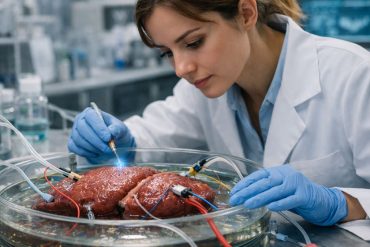
3D bioprinting involves layering human cells and biomaterials to create structured tissues. These printed tissues can be used for disease modeling, drug screening, and regenerative research. By constructing tissue systems from human cells, scientists can study how diseases develop and how treatments interact with human tissue architecture. - Computational and In Silico Models
Computer simulations are also a key component of human-relevant models. These computational systems analyze large biological datasets to predict how drugs will behave in the human body. They can simulate metabolism, toxicity, and biological responses before therapies ever reach clinical testing. - Human-Derived Cells and Tissues
Researchers also use primary human cells, patient-derived tissues, and induced pluripotent stem cells to study disease mechanisms. These materials allow scientists to explore how real human biology responds to treatments and environmental factors.
Together, these approaches provide a toolkit that allows biomedical researchers to study human biology more directly.
How These Models Address the Limits of Animal Research
Human-relevant models attempt to address the central problem identified in traditional research systems: the mismatch between experimental models and real human biology.
By using human cells and recreating human physiological conditions, these systems can reveal risks and responses that animal models may miss. Researchers can observe how different tissues communicate, how immune responses develop across organs, and how drugs affect multiple biological systems simultaneously.
This approach can help identify potential problems earlier in the research process. If a therapy produces harmful or ineffective results in human-relevant systems, scientists can refine or abandon the approach before investing years in expensive clinical trials.
Alice Gilman, a regenerative biology researcher involved in human-relevant research systems, has argued that scientific reliability and ethical considerations are closely connected in this field. She suggests that researchers must ask not only whether results look promising but also whether the model itself is capable of answering the biological question being studied.
This reframing does not eliminate uncertainty, but it can make scientific assumptions more transparent and more closely tied to real outcomes.
The Advantages of Human-Relevant Models
Human-relevant research systems offer several advantages that researchers believe could improve biomedical science.
One major benefit is improved predictive power. Because these systems replicate aspects of human physiology and genetics, they may better predict whether a therapy will succeed in clinical trials.
They also support precision medicine. Patient-derived organoids allow scientists to test treatments on tissues that match individual genetic profiles. This makes it possible to explore personalized treatment strategies for diseases such as cancer or genetic disorders.
Another advantage is improved disease modeling. Some complex diseases, particularly neurodegenerative disorders, are difficult to replicate in animals. Human-relevant systems allow scientists to study these conditions in environments that more closely resemble the human body.
These models also improve toxicity testing. High-throughput screening systems can analyze how drugs interact with human tissues and identify harmful effects earlier in development.
The National Institutes of Health and other regulatory organizations are increasingly prioritizing these methodologies because they may reduce reliance on animal testing while improving research accuracy and accelerating drug development.
Research Moving this Direction
The movement toward human-relevant models is gaining support across biomedical research. Many scientists see it as a necessary step toward aligning scientific methods with the complexity of modern medicine.
Gilman emphasizes that the goal is not to dismiss earlier research methods but to improve how science is conducted. According to her perspective, ethical innovation and scientific rigor can reinforce each other rather than conflict.
Morgan’s article reflects a broader sentiment among researchers that the models used in early experiments shape everything that follows. If the starting assumptions are flawed, the entire development pipeline may produce misleading results.
This realization is pushing laboratories, regulatory agencies, and research organizations to reconsider how preclinical science is conducted.
Biomedical research is advancing rapidly through breakthroughs in genomics, regenerative medicine, and data analysis. Yet the experimental models used to study human disease have not always kept pace with these advances.
Human-relevant systems offer a potential path forward by aligning research tools with the biological complexity of the human body. Instead of relying on simplified animal systems, scientists are building platforms designed around human biology itself.
Morgan concludes that progress in life-saving medicine begins long before a therapy reaches patients. It starts with the models used to ask the first questions and with the willingness to reconsider whether those models still serve human health as well as they should.