


A Breakthrough in Understanding Complex Life
For billions of years, life on Earth has evolved from simple, single-celled organisms into the vast complexity we see today. One of the most pivotal events in this process was endosymbiosis—a biological partnership where one organism lives inside another, eventually leading to the formation of crucial cellular structures like mitochondria and chloroplasts.
Now, for the first time, scientists have successfully recreated the early stages of this process in a laboratory. Researchers at the Swiss Federal Institute of Technology Zurich have induced endosymbiosis between bacteria and fungi, providing groundbreaking insights into how these cellular partnerships form and evolve.
What Is Endosymbiosis?
Endosymbiosis occurs when one microorganism takes up residence inside another, forming a relationship that, under the right conditions, can last for generations—or even billions of years. This process is the foundation of complex life as we know it.
Examples of endosymbiosis are all around us:
- Mitochondria, the powerhouses of our cells, were once free-living bacteria.
- Chloroplasts, which enable plants to photosynthesize, also originated from independent organisms.
- Many insects rely on bacteria inside them to produce essential nutrients.
Despite its importance, scientists have long struggled to understand how these relationships begin. What prevents an engulfed organism from being digested? How do two separate entities learn to coexist and eventually depend on each other? This new study offers the first direct observations of these processes unfolding in real-time.
Recreating Endosymbiosis in the Lab
To investigate the origins of endosymbiosis, microbiologist Julia Vorholt and her team turned to a known natural pairing: the fungus Rhizopus microsporus and the bacterium Mycetohabitans rhizoxinica. This duo is infamous for causing rice seedling blight, a disease where the bacteria produce toxins that benefit the fungus by killing plant cells and providing nutrients.
The team hypothesized that if they could reintroduce bacteria into a strain of Rhizopus that lacked endosymbionts, they might witness the formation of a new symbiotic relationship. However, they faced a significant physical challenge: how to get bacteria past the fungus’s rigid cell wall.
The Ingenious Experiment
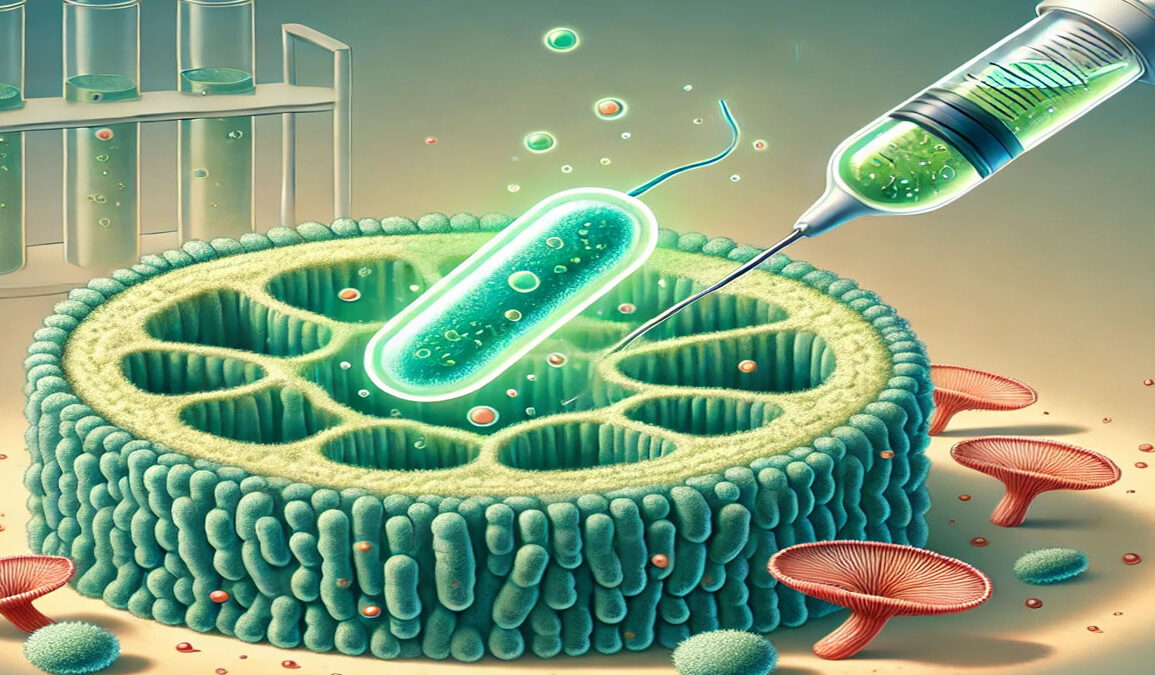
Graduate student Gabriel Giger devised an unconventional solution. First, he treated the fungal cells with enzymes to soften their walls. Then, he used a microneedle—connected to a bicycle pump—to inject bacteria directly into the fungal cells.
This method allowed researchers to introduce different bacteria and observe their fates. When E. coli was injected, it reproduced too rapidly, triggering the fungus’s immune defenses, which quickly eliminated it. However, when Mycetohabitans rhizoxinica was introduced, a remarkable process began: the bacteria survived, reproduced at a manageable rate, and gradually integrated into the fungal spores—ensuring their passage to future generations.
Evolution in Action
Over the course of ten fungal generations, researchers observed a profound shift. Not only did the bacteria continue to thrive inside the fungus, but the fungus itself began to change. Genetic mutations in the fungal genome suggested it was adapting to accommodate its new bacterial partner. This confirmed a key aspect of endosymbiosis: for a relationship to become stable, both organisms must evolve in harmony.
As Vorholt explained, “They become addicted to each other.”
The Implications for Science and Biotechnology
This experiment marks the first time scientists have successfully induced and observed endosymbiosis forming in real-time. The findings offer a clearer picture of how life’s complexity emerged billions of years ago and could have major implications for bioengineering.
By engineering bacteria with specific traits and introducing them into host organisms, scientists could potentially develop new symbiotic systems to:
- Break down environmental pollutants 🌱
- Produce medicines 💊
- Improve agricultural resilience 🌾
While this research provides exciting possibilities, don’t expect humans to evolve to photosynthesize anytime soon. As Giger jokingly put it, “You might get fancy green skin, but you’d still need pizza to survive.”
A New Frontier in Evolutionary Science
By recreating the delicate dance of microbial partnerships, scientists have taken a major step toward understanding one of life’s greatest mysteries: how simple cells gave rise to the vast complexity of multicellular organisms. This study not only illuminates our past but also opens the door to future innovations in synthetic biology and medicine.