

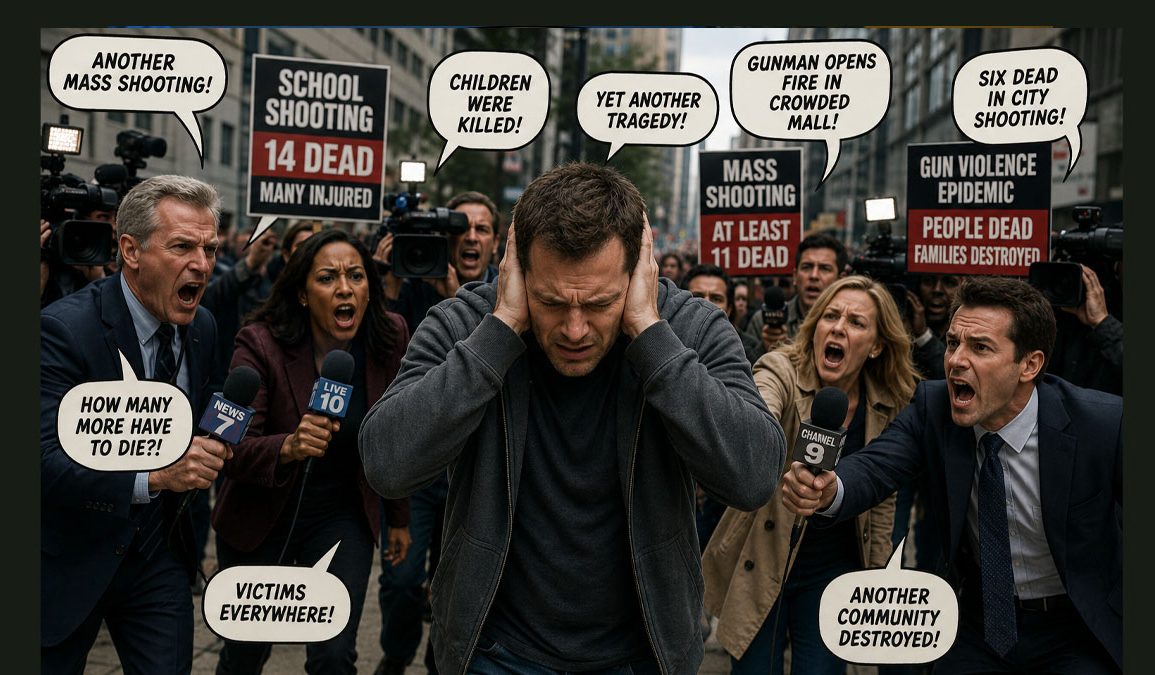
Americans are surrounded by stories of gun violence. Every day there are headlines about school shootings, mass killings, neighborhood shootings, domestic violence, and suicides involving firearms. Television coverage loops dramatic footage. Social media feeds replay the same stories endlessly. Smartphones make it nearly impossible to escape. Researchers are increasingly warning that this constant exposure is taking a serious toll on the nation’s mental health.
A growing body of research now suggests that repeatedly consuming news about real-world gun violence can increase depression, anxiety, stress, emotional numbness, and feelings of fear, even among people who were never directly involved in a shooting. Unlike violence in movies or video games, these events are real. Viewers know that real people died, real families were shattered, and real communities were traumatized. That reality appears to make the psychological impact much more powerful.
From the NJ Gun Violence Research Center
One of the leading researchers studying this issue is Devon Ziminski, a postdoctoral fellow at the New Jersey Gun Violence Research Center at the Rutgers School of Public Health in Piscataway, New Jersey. Ziminski and her colleagues examined how exposure to media coverage of gun violence affects mental health across the United States.
The researchers surveyed approximately 5,000 adults nationwide and studied their exposure to gun violence coverage through television, newspapers, social media, and online news. Their findings were alarming. People who experienced greater exposure to gun violence news were 51% more likely to report a higher number of poor mental health days each month. They were also 21% more likely to report symptoms of depression.
Ziminski said the results show that “cumulative media exposure to real-world firearm violence could contribute to a mental health burden, even for those not personally involved in an incident.” She also warned that repeated exposure to mass shootings and violent events can reinforce feelings of personal danger, even among people who live in relatively safe communities.
That matters because Americans consume enormous amounts of media. Researchers noted that 84% of U.S. adults use social media and 44% prefer watching the news. When stories involving gun violence dominate those platforms, millions of people absorb disturbing images and narratives repeatedly throughout the day.
Why the Brain Reacts So Strongly
Mental health experts say the human brain does not easily separate direct danger from repeatedly witnessing danger through a screen. Registered Clinical Counselor Niloufar Esmaeilpour explained that violent media repeatedly activates the brain’s “threat system,” keeping people in a constant state of fear and vigilance.
She warned that even if someone is not personally at risk, repeatedly seeing shootings, victims, police responses, and emergency scenes can cause people to misjudge how dangerous the world really is. Chronic exposure can lead to sleep disturbances, irritability, emotional numbness, anxiety, and depression.
Psychiatrist Dr. Clint Salo added that “the brain doesn’t fully distinguish between witnessing violence directly and consuming it repeatedly through a screen.” He said constant exposure keeps the nervous system in a “low-grade state of vigilance,” which slowly contributes to depression, anxiety, and distorted perceptions of danger.
This effect has become even stronger because modern social media algorithms are designed to maximize engagement. Fear, outrage, and shocking content generate clicks, shares, and emotional reactions. As a result, violent stories are often amplified and shown repeatedly.
William Brangham
PBS journalist William Brangham has spoken publicly about how widespread gun violence has become and how normalized it now feels in America. During one report, he pointed out that in just 72 hours there had been more than 175 shootings in the United States where someone was shot or killed.
Brangham noted that many shootings never even become national news stories, but still leave lifelong trauma for victims, families, and entire neighborhoods. He discussed how the normalization of shootings has created what many experts now describe as a persistent public health crisis.
In his interview with Dr. Emmy Betz, Brangham explored whether Americans have become desensitized to gun violence. Betz acknowledged that many people have, partly because of the nonstop stream of disturbing events competing for public attention. However, she argued that Americans should not accept this as “the new normal.”
Betz also emphasized that the psychological effects extend far beyond direct victims. People change their behavior because of fear. Children practice active shooter drills. Families avoid crowded places. Survivors and witnesses often carry trauma for years or even decades.
But Ziminski’s research indicates that perhaps we are not completely desensitized. In our opinion at HNZ, these two conclusions are not incompatible. As an analogy, when an animal is whipped constantly and seems to be resigned to it, it does not mean that mental damage is not being done and in fact that mental damage often becomes dramatically apparent.
Children and Teenagers Are Especially Vulnerable
Researchers say children and teenagers may be suffering the most severe psychological effects. The American Psychological Association described a “cascade of collective traumas” affecting the nation. Young people are growing up in a world where school shootings are part of daily conversation and emergency drills are routine.
Studies show that fear of school shootings is linked with increased anxiety among students. Some psychologists report that children now regularly plan escape routes in public spaces in case violence erupts.
Researchers also found that stress related to shootings can interfere with learning and concentration. When students remain in a heightened state of fear, the brain devotes more energy to survival responses and less to memory, attention, and learning.
The Dangerous Cycle of Doomscrolling
Psychologist Kelsey Petrey warned about the effects of what many now call “doomscrolling.” This refers to endlessly consuming negative news on smartphones and social media. Petrey explained that modern technology exposes people to nonstop reports of wars, violence, disasters, suicides, and shootings from all over the world.
Research she cited found that repeated exposure to negative media is associated with trauma symptoms, increased distress, and stronger emotional reactions. People with previous traumatic experiences may be especially vulnerable.
Petrey argued that the sheer volume of negative media may eventually outweigh the benefits of constant information access. In other words, people are not psychologically built to absorb endless streams of tragedy every day without consequences.
Mental Illness and Media Framing
Researchers have also warned that news coverage can distort public understanding of mental illness. A major study examining news coverage from 1997 to 2012 found that stories about serious mental illness and gun violence were heavily concentrated around mass shootings. Most of the coverage focused on “dangerous people” rather than broader social issues or access to weapons.
The study found that news reports rarely reminded audiences that most people with serious mental illness are not violent. Researchers worried that this type of coverage increases stigma and fear while encouraging the public to associate mental illness with violence.
What Experts Suggest
Researchers are not suggesting that Americans stop following the news completely. Instead, many recommend limiting repetitive exposure to distressing content.
Esmaeilpour recommends creating a “news dosing schedule,” setting aside limited times during the day for news consumption instead of constantly scrolling through updates. She also suggests choosing higher quality news sources that avoid endlessly replaying graphic content.
Experts additionally recommend taking breaks after consuming stressful news. Activities like walking, listening to music, exercising, or talking with others can help calm the nervous system and interrupt the constant state of fear and vigilance.
HNZ Editor: The news covers what people want to watch, and it evolves in whatever direction attracts the most viewers. And of course advertisers want to sponsor the news outlets with the most viewers, thus subsidizing this kind of content. This is a tough nut with a lot more complexity that is apparent from the birds eye view.