


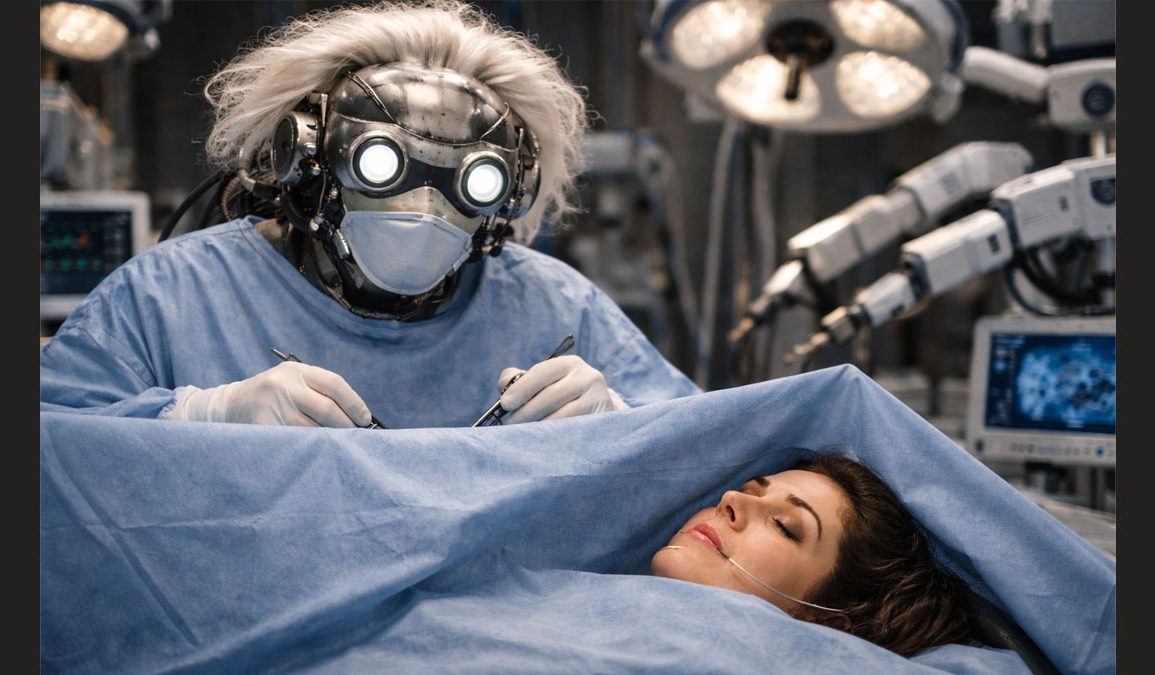
Robotic surgery is changing how doctors treat serious disease by combining human skill with advanced machines that improve precision and visibility. In most cases, surgeons sit at a console and control robotic arms equipped with tiny instruments and cameras. The robot does not act on its own. Instead, it translates the surgeon’s movements into smaller, steadier motions inside the body. This approach often allows for smaller incisions, less pain, shorter hospital stays, and faster recovery. Recent cases across the country show how robotic surgery is expanding into cancer care, hernia repair, joint replacement, and even organ transplantation.
Robotic lung surgery leads to a five year lung cancer cure
At University of Iowa Health Care, cardiothoracic surgeon Evgeny Arshava used robotic-assisted surgery to remove early-stage lung cancer from Sharon Chamberlin, a former smoker. Her cancer was detected through routine screening and treated with a robotic left lower lobectomy and lymph node removal. The robotic system allowed greater visibility and precision through small incisions between the ribs. Five years later, Chamberlin remains cancer-free, which doctors consider a cure. Surgeons say this approach can reduce pain, shorten hospital stays, and improve long-term outcomes for eligible patients.
Robotic-assisted lung surgery becomes standard practice
At Fox Chase Cancer Center, thoracic surgeons Louis Chai and Lisa Bevilacqua say robotic systems are now essential tools in lung cancer surgery. They use five small incisions instead of one large cut, which helps reduce pain and recovery time. The surgeons stress that humans remain fully in control, with the robot acting as a precision instrument. They say robotic surgery allows better visualization and flexibility, especially for complex cases. Doctors also emphasize that early detection through annual CT scans remains critical to making surgery simpler and more effective.
First robotic hernia surgery at a VA and Navy hospital
The Captain James A. Lovell Federal Health Care Center completed its first robotic surgery using the new da Vinci 5 system. Surgeon Alex Farnand led the team in repairing an Army veteran’s bilateral hernias. The hospital was the first VA facility to bring the da Vinci 5 into operation. Staff described the launch as a major milestone that required years of planning and training. Farnand says the robot allows surgeons to keep more procedures minimally invasive, reducing pain, blood loss, and hospital stays while offering veterans access to modern standards of care.
Robotic precision improves knee replacement surgery
At Corpus Christi Medical Center, doctors are using robotic-assisted technology to perform knee replacement surgeries with greater accuracy. Orthopedic surgeon Connor Armstrong explains that the robot helps create detailed 3D models of each patient’s knee before surgery. This allows precise planning of implant size and placement down to fractions of a millimeter. The robot does not perform the surgery but guides the surgeon during key steps. Hospital leaders say this added precision can lead to smoother recoveries and better long-term function for patients suffering from severe joint pain.
Nation’s first fully robotic liver transplant
Surgeons at the VCU Health Hume-Lee Transplant Center performed the first fully robotic living-donor liver transplant in the United States. Led by surgical director Seung Duk Lee, the team used robotic systems to handle one of the most complex transplant procedures in medicine. The approach may reduce recovery time for donors and recipients while expanding access to transplants. Lee says robotic techniques could encourage more people to become living donors. U.S. News highlighted the case as a milestone that could reshape how advanced organ transplants are performed.
Doctors across these institutions say robotic surgery is no longer experimental but an evolving standard of care. Patients often report less pain and faster recovery, while surgeons point to improved precision and visibility. As technology continues to improve, experts believe robotic systems will make complex surgeries safer and available to more patients, provided they are matched carefully to the right cases and guided by experienced surgical teams.