


This is followup information to an article we published a couple of days ago on plasma exchange – this research is among the best for practical anti-aging, in our view.
Dr. Paul Savage has just announced a new plasma exchange protocol that he believes could have a major impact on how we fight aging and chronic diseases. Speaking at the 2024 Age Management Medicine Group Conference in Miami, Dr. Savage, the founder of MDLifespan, revealed that therapeutic plasma exchange (TPE) can remove toxins from the body, reduce inflammation, and improve many health markers. “Our mission is to ensure that patients have the tools to take control of their health, now and in the future,” Dr. Savage said in a statement.
Dr. Savage, once an emergency room doctor, has dedicated his career to wellness and longevity. His new protocol takes advantage of TPE, a medical procedure that removes a patient’s plasma and replaces it with a clean solution like saline or albumin. He described this as an “oil change for the body,” helping to flush out environmental toxins and harmful substances that build up in our bloodstream.
Promising Data on Health Improvements
According to Dr. Savage’s findings, the results of this protocol are impressive. His team’s research showed:
- Heavy metals decreased by an average of 80 percent, with aluminum showing a complete 100 percent decrease
- Phthalates dropped by up to 97 percent
- Environmental toxins reduced by up to 95 percent
- Health biomarkers improved by up to 95 percent
- Inflammation decreased by up to 50 percent
- Oxidative stress went down by up to 50 percent
- The immune system improved by up to 40 percent
Dr. Savage sees this as a practical way to combat what he calls the “existential threat of environmental toxins.” He explained, “The convergence of 30 years of expertise in medical research and technological innovation has created a paradigm shift in our approach.”
Irina Conboy’s Work: Less About Young Blood, More About Removing Old
While Dr. Savage’s results are exciting, they build on years of earlier research by scientists like Irina Conboy at the University of California, Berkeley. In her landmark 2020 study, Conboy showed that the benefits of plasma exchange might not come from adding young blood, but from removing the harmful factors in old blood.
Conboy’s study replaced half the plasma in older mice with a neutral saline-albumin solution, leading to better brain function, reduced inflammation, and even improved muscle and liver health. “The removal of old plasma seems to be enough to rejuvenate tissue and reduce age-related decline,” Conboy said at the time. Her research suggests that “getting rid of what’s bad in old blood may matter more than adding anything new.”
Bryan Johnson: Another Data Point
This idea of plasma exchange as a potential anti-aging tool has even reached the high-tech world of gazillionaire biohacker Bryan Johnson. Johnson, known for his expensive and sometimes controversial health experiments, recently stopped injecting his son’s blood and switched to full plasma exchange therapy instead. While Johnson claims this therapy has “measurable effects in delaying and reversing age-related disease,” most experts still see his experiments as only one data point in a much larger scientific effort.
As Shannon Starweather from Neuroveda Health explained, “It’s like an oil change for your blood. It removes, cleans, and separates the plasma before returning it with albumin.” However, Starweather also warned that “the frequency of TPE must be carefully considered, as excessive treatments without appropriate medical oversight may strain the body’s ability to maintain homeostasis.”
Exploring New Ideas with Young Pig Plasma
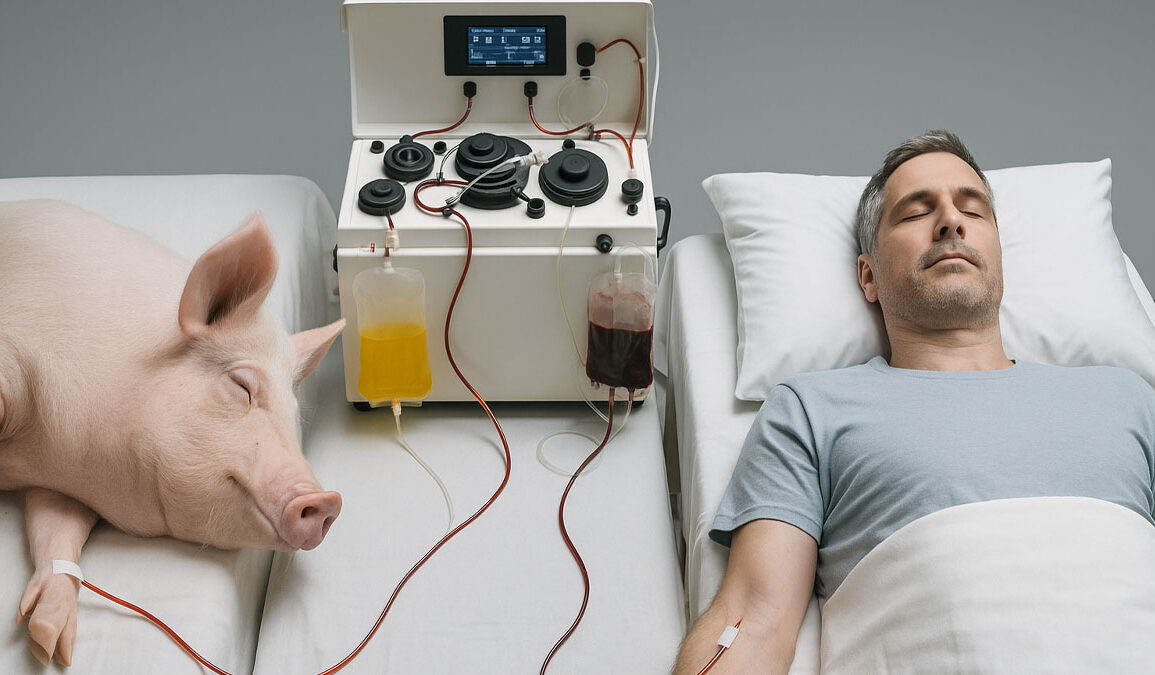
Interestingly, recent animal research has also pushed the boundaries of plasma exchange even further. A study from UCLA showed that using plasma from young pigs could reverse the biological age of rats’ hearts, livers, and brains. The liver’s biological age dropped by 74.6 percent, the heart’s by 46.5 percent, and the brain’s by 24.4 percent. These findings are helping scientists understand how removing old plasma and introducing new proteins and factors could work together to slow down aging.
A Field Full of Promise
With so many new studies and protocols coming out, plasma exchange is getting serious attention in the wellness and anti-aging community. Dr. Savage believes his PlasmaXchange protocol could be the key to reducing the harmful effects of environmental toxins that he says contribute to heart disease, cancer, Parkinson’s, and Alzheimer’s.
For now, the promise of plasma exchange lies in its ability to “reset” the body’s internal environment. “One of the most compelling aspects of TPE is its impact on immune and metabolic function,” Dr. Savage said. “By lowering the body’s toxic burden and reducing systemic inflammation, TPE has been associated with increased energy, improved cognitive clarity, and enhanced immune resilience.”
Still, many researchers, including Irina Conboy, caution that these therapies need more large-scale human studies before anyone can declare plasma exchange the ultimate cure for aging. Conboy herself remains a leading voice for careful science over hype.
As these scientists continue to refine their techniques, the future of anti-aging and detoxification medicine seems closer than ever. While more questions need answers, plasma exchange could be an important step in helping us all live healthier, longer lives. Let me know if you’d like to track these developments or explore what this might mean for your health journey.