

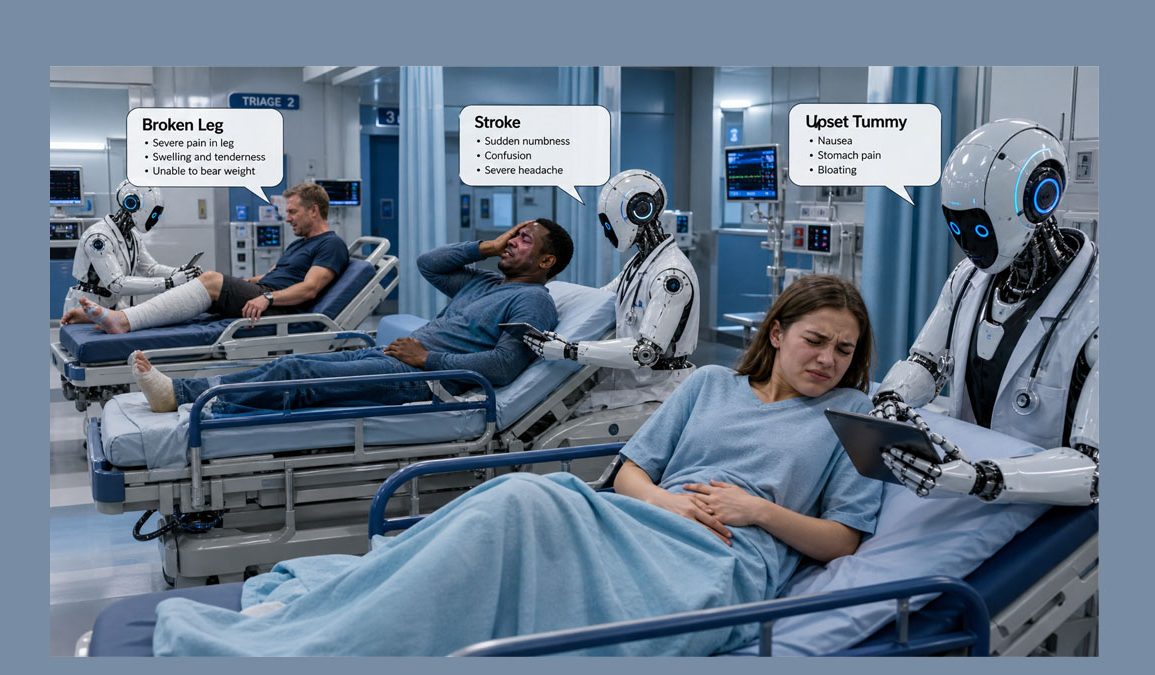
A new peer reviewed study from researchers at Harvard Medical School and Beth Israel Deaconess Medical Center is fueling a major debate about the future of medicine after artificial intelligence systems outperformed physicians in several emergency room diagnostic tasks. The research, published in the journal Science, found that advanced AI systems could often diagnose patients more accurately than human doctors when evaluating real emergency room cases.
The study focused on large language model AI systems, often called LLMs, which are capable of analyzing text, recognizing patterns, and reasoning through complicated medical information. Researchers tested the systems using real patient data from emergency room visits and compared the AI’s conclusions directly against those of experienced physicians.
According to the study, the AI systems either matched or exceeded doctor performance across nearly every benchmark that researchers tested. Arjun Manrai of Harvard Medical School, one of the senior co authors, said the results surprised even the researchers themselves.
“We tested the AI model against virtually every benchmark, and it eclipsed both prior models and our physician baselines,” Manrai said.
One of the most important experiments in the study focused on 76 real patients who arrived at the emergency room of a Boston hospital. Both the AI system and human doctors were given identical information from electronic health records. This included vital signs, demographic information, and brief notes describing the patient’s symptoms and condition upon arrival.
Researchers then asked independent attending physicians, who did not know whether the diagnoses came from humans or AI, to evaluate the quality and accuracy of the answers.
The results strongly favored the AI.
The OpenAI o1 reasoning model correctly identified the exact or very close diagnosis in 67% of emergency room triage cases. Human physicians, by comparison, achieved accuracy rates between 50% and 55%.
Researchers found that the AI advantage became especially noticeable during the earliest stages of emergency room evaluation, when doctors have very little information and must make rapid decisions under pressure. The study described these moments as the most urgent and difficult diagnostic situations.
When researchers later gave both the AI and human doctors additional medical details, the AI’s diagnostic accuracy climbed to 82%, while expert physicians reached between 70% and 79%. Although that later difference was not considered statistically significant, the AI still performed at least as well as top human experts.
The study also found that AI performed better in developing long term treatment strategies. In one experiment involving five clinical case studies, the AI scored 89% on treatment planning tasks, while physicians using traditional resources such as search engines scored only 34%.
Researchers said the AI showed particular strength in recommending next steps in treatment, identifying likely diagnoses, and making emergency care decisions.
Cases Where AI Beat Human Doctors
One real world example described in the study involved a patient suffering from blood clots in the lungs and worsening symptoms. Human doctors believed the patient’s blood thinning medication was failing. The AI, however, noticed something the physicians missed.
The patient had a history of lupus, and the AI suggested that lupus related inflammation was actually causing the lung problems. Researchers later confirmed that the AI’s diagnosis was correct.
Researchers believe these kinds of results demonstrate that AI systems are becoming increasingly capable of clinical reasoning rather than simply memorizing medical facts.
The study itself concluded that LLM systems “have eclipsed most benchmarks of clinical reasoning.”
Independent experts agreed the results represented a major step forward.
Professor Ewen Harrison, co director of the University of Edinburgh’s Centre for Medical Informatics, said the systems were beginning to look like “useful second opinion tools for clinicians, particularly when it is important to consider a wider range of possible diagnoses and avoid missing something important.”
Researchers Say AI Will Not Replace Doctors Yet
Despite the impressive results, the study’s authors repeatedly stressed that AI is not ready to replace emergency room physicians.
“I don’t think our findings mean that AI replaces doctors,” Manrai said. “I think it does mean that we’re witnessing a really profound change in technology that will reshape medicine.”
Dr. Adam Rodman of Beth Israel Deaconess Medical Center described AI as one of “the most impactful technologies in decades.” He predicted that healthcare could eventually evolve into what he called a “triadic care model” involving “the doctor, the patient, and an artificial intelligence system.”
Researchers also emphasized an important limitation of the study. The AI systems only analyzed text based information from patient records. They could not evaluate visual cues, physical appearance, emotional distress, body language, or other nontext information that doctors routinely use in real emergency rooms.
Peter Brodeur, the study’s first co author, warned that AI systems could still create dangerous problems if used improperly.
“A model might get the top diagnosis right but also suggest unnecessary testing that could expose a patient to harm,” Brodeur said. “Humans should be the ultimate baseline when it comes to evaluating performance and safety.”
Rodman also warned there is currently “no formal framework right now for accountability” involving AI generated diagnoses. He added that patients still “want humans to guide them through life or death decisions.”
Skeptics Warn About Overhype
Not everyone is convinced the results prove AI is ready for widespread emergency room use.
Emergency physician Kristen Panthagani criticized some of the headlines surrounding the study and argued the comparisons may not fully reflect real emergency medicine.
“This is an interesting AI study that has led to some very overhyped headlines,” Panthagani said.
She pointed out that the study compared the AI systems against internal medicine attending physicians rather than specialized emergency room doctors.
“If we’re going to compare AI tools to physicians’ clinical ability, we should start by comparing to physicians who actually practice that specialty,” she said.
Panthagani also argued that emergency medicine is not simply about identifying the final diagnosis.
“As an ER doctor seeing a patient for a first time, my primary goal is not to guess your ultimate diagnosis,” she explained. “My primary goal is to determine if you have a condition that could kill you.”
Other experts raised concerns that doctors could become overly dependent on AI recommendations. Dr. Wei Xing of the University of Sheffield warned that physicians might unconsciously defer to AI conclusions instead of thinking independently.
“This tendency could grow more significant as AI becomes more routinely used in clinical settings,” Xing warned.
Still, the Harvard study represents one of the strongest indications yet that artificial intelligence may soon become a permanent part of emergency medicine. Researchers say the next step will be conducting real world clinical trials to determine whether AI systems can safely assist physicians in live patient care settings.